Kōrero: Otago places

Seacliff lunatic asylum

Image
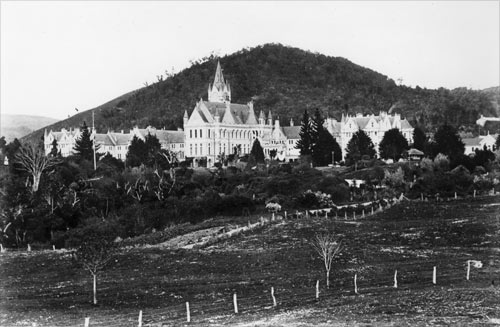
Seacliff lunatic asylum

The Seacliff lunatic asylum was a large assemblage of buildings 28 kilometres north of Dunedin. Designed by architect Robert Lawson in a style that has been described as ‘Scottish baronial’, the building ruined his career when structural defects were found in it. When Truby King was superintendent, from 1889 to 1921, creative forms of treatment were pioneered.

Te whakamahi i tēnei tūemi

Hocken Collections, University of Otago

Reference: S09-038d

Permission of the Hocken Collections Uare Taoka o Hakena, University of Otago, must be obtained before any re-use of this image. Further information may be obtained from the Library through its website.

Ngā whakaahua me ngā rauemi katoa o tēnei kōrero

Me pēnei te tohu i te whārang

Malcolm McKinnon, Otago places – North of Dunedin, Te Ara – the Encyclopedia of New Zealand, https://teara.govt.nz/mi/photograph/22751/seacliff-lunatic-asylum (accessed 4 June 2026).

He kōrero nā Malcolm McKinnon, i tāngia i te 19 August 2009, updated 1 July 2015.

Comments

Ian Smith
13 June 2014
The failure of the old Seacliff 'Lunatic Asylum' main building was due to it having been located on part of the Abbotsford Mudstone Formation, which underlies much of the region between Hampden in the North and South of Brighton, near Dunedin. Travellers on the main highway between Evansdale and Cherry Farm will have long been familiar with the constant 'road-slumps' on Kilmog Hill, with their accompanying warning signs. That is due to poor adhesion between layers of a soap-like stone, when water has been able to penetrate between them, acting as a lubricant. The 'Asylum' building succumbed to such movement. It is highly unlikely that Lawson had been warned of this phenomenon and the blame rests, possibly, not on the architect, but whoever it was selected the site. The extensive gardens which Truby-King promoted as an alternative to having his 'lunatics' incarcerated in cells, like criminals, (by giving them productive work to keep them occupied), are part of a reserve which makes a surprisingly good picnic spot. Part of the foundations of the 700 foot long building may still be viewed, and the extent of the cracking is very apparent.