Kōrero: Pacific migrations

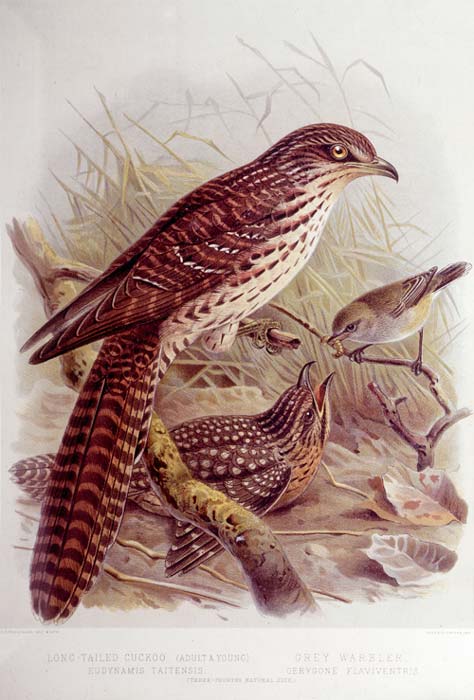
Te koekoeā (long-tailed cuckoo) me te riroriro (grey warbler).

Image
Long-tailed cuckoo with grey warbler

Hei te takurua tau ai te koekoeā ki ngā moutere o Te Moana-nui-a-Kiwa, ā, hei te kōanga rere whakatetonga ai rātou. Kāore e kore i mātakina ēnei haerenga me ēnei hokinga e ngā tāngata kei aua moutere e noho ana. I mōhio rātou, e rere ana aua manu ki tētahi whenua kei tua o te pae o te rangi. Nā tēnei pea i ara ake ngā kōrero me ngā pātai mō ngā moutere kei te wai nui.

Te whakamahi i tēnei tūemi

Alexander Turnbull Library

Reference: PUBL-0012-14

by John Gerrard Keulemans

Permission of the Alexander Turnbull Library, National Library of New Zealand, Te Puna Mātauranga o Aotearoa, must be obtained before any re-use of this image.

Ngā whakaahua me ngā rauemi katoa o tēnei kōrero

Me pēnei te tohu i te whārang

Geoff Irwin, Pacific migrations – East to the empty Pacific, Te Ara – the Encyclopedia of New Zealand, https://teara.govt.nz/mi/artwork/1792/te-koekoea-long-tailed-cuckoo-me-te-riroriro-grey-warbler (accessed 1 July 2026).

He kōrero nā Geoff Irwin, i tāngia i te 4 March 2009, updated 8 February 2017.

Comments

Gerald Hanner
04 September 2022
I suspect that when the Polynesians saw the Pacific Golden Plovers wing off northward to get to their Alaskan breeding grounds they might have deduced that land lay in that direction. They would be correct in that deduction, but they would be in for a surprise, climate-wise. I have wondered if it is a coincidence that a lot of the costal Indian tribes in Canada and Alaska look a lot like Polynesians. And a lot of their totems seems to have a strong Polynesian appearance.