Kōrero: Pounamu – jade or greenstone

Ngā takotoranga o te pounamu ki Te Wai Pounamu

Image
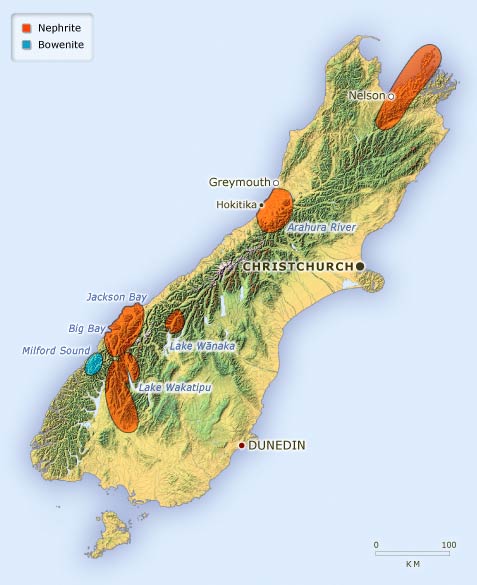
New Zealand’s pounamu deposits

Ngā takotoranga o te pounamu ki Te Wai Pounamu. Ko te nuinga o te pounamu ko te momo o te nephrite, i tua atu i te bowenite kei Piopiotahi (Milford Sound).

Te whakamahi i tēnei tūemi

Te Ara - The Encyclopedia of New Zealand

Source: Russell J. Beck with Maika Mason, Mana pounamu: New Zealand jade. Auckland: Reed, 2002, p. 26

This item has been provided for private study purposes (such as school projects, family and local history research) and any published reproduction (print or electronic) may infringe copyright law. It is the responsibility of the user of any material to obtain clearance from the copyright holder.

Ngā whakaahua me ngā rauemi katoa o tēnei kōrero

Me pēnei te tohu i te whārang

Basil Keane, Pounamu – jade or greenstone – Pounamu – several names, Te Ara – the Encyclopedia of New Zealand, https://teara.govt.nz/mi/map/7649/nga-takotoranga-o-te-pounamu-ki-te-wai-pounamu (accessed 7 July 2026).

He kōrero nā Basil Keane, i tāngia i te 2 March 2009.

Comments

Anonymous
23 April 2013
Nephrite is essentially a calcium silicate composition with varying amounts of iron. Extremely tough, the stone is made up of densely interwoven fibres that will bend before breaking thus giving it an incredible toughness as well as a hardness equivalent to steel. Despite this strength and hardness, those who work closely with nephrite often describe it as having a waxy, soapy, talc-like or rich, resinous feel. Somewhat rarer than nephrite, jadeite’s interlocking granular structure of tiny sodium aluminum silicate crystals make it even harder than nephrite. Jadeite carvings are characterized by rounded edges; jadeite cannot be worked to a sharp point or edge the way fibrous nephrite can, and is more easily broken or chipped due to its crystalline structure. This hardness dictates that both nephrite and jadeite need high-speed diamond cutting tools; a far cry from the traditional labour-intensive methods used when carvers employed loose grit or sandstone to wear away the stone.
aimee
01 November 2011
i like the map of where the pounamuis found