Kōrero: Whanganui places

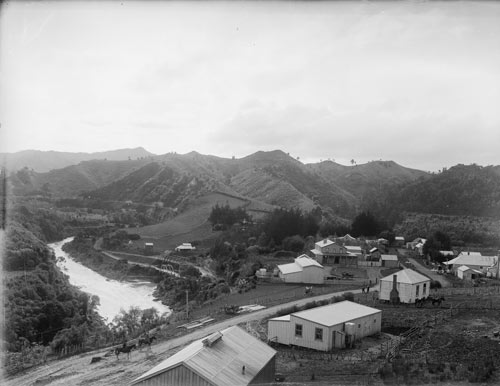
Mangamāhū, 1906

Image
Mangamāhū, 1906

Mangamāhū, at the junction of the Mangamāhū and Whangaehu rivers, remains a remote settlement. In 2006 it was cut off for several weeks when flood waters destroyed a bridge on the only access road. A century earlier it was a youthful settlement, with the surrounding hillsides only recently cleared of forest.

Te whakamahi i tēnei tūemi

Alexander Turnbull Library, Tesla Studios Collection (PAColl-3046)

Reference: G-13108-1/1

Permission of the Alexander Turnbull Library, National Library of New Zealand, Te Puna Mātauranga o Aotearoa, must be obtained before any re-use of this image.

Ngā whakaahua me ngā rauemi katoa o tēnei kōrero

Me pēnei te tohu i te whārang

Diana Beaglehole, Whanganui places – East of Whanganui, Te Ara – the Encyclopedia of New Zealand, https://teara.govt.nz/mi/photograph/18952/mangamahu-1906 (accessed 4 June 2026).

He kōrero nā Diana Beaglehole, i tāngia i te 3 March 2009, updated 15 June 2015.

Comments

John Archer
20 March 2024
I was born in 1941 and spent my preschool years in the kitchen of my grandparents' hotel in the Mangamahu village The nearest building in the photo is the coach house, (It was pulled down after dad built our house behind it in 1955) The next building is the carriers' wagon shed. It was my dad's lorry shed and three 5-ton trucks could fit inside it. After the 1953 Tangiwai disaster, the police refused to collect bodies from the river and the army failed show up also. Consequently, dad had to collect them (mostly young women, stripped naked by the flood of mud) on one of his flatbed trucks and store them in that shed, right beside our dining room. Over 4 weeks, 40 bodies were stored and cleaned up there. Another carrier came out from Whanganui each evening and took the day's collection to the police. Dad pulled the shed down not long afterwards The third building was originally the Upper Whangaehu Roads Board office, then the Mangamahu school and village hall for dances, 500 card evenings and dinners, then then the rugby club hall. It was later mover across the river to the domain. The Mangamahu store and Post and Telegraph office is behind and to the right of the Hall. You can see the telephone line in bigger copies of this picture.The hotel and its livery stables are to the left of the store. Life in this 1905 village is described in vivid detail in Merv Addenbrooke's autobiography "Home From The Hill."