Kōrero: Advertising

Dinneford's Magnesia

Image
Dinneford's Magnesia

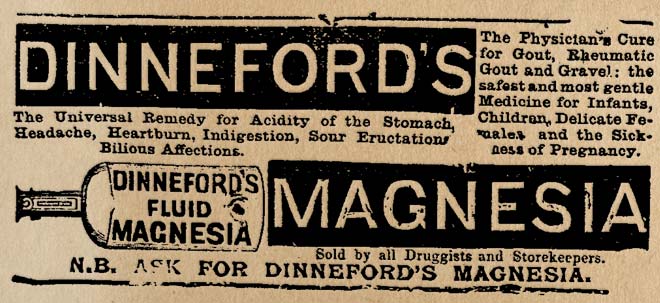
This advertisement from the Bay of Plenty Times, June 1887, was typical of the inflated claims for patent remedies that were to be found in many newspaper advertisements at the end of the 19th century. Few of them did not claim to cure virtually all medical problems from heartburn to gout, and they claimed to be suitable for both children and ‘delicate females’.

Te whakamahi i tēnei tūemi

National Library of New Zealand, Papers Past

Reference: Bay of Plenty Times, 1 June 1887, p. 4

Permission of the National Library of New Zealand, Te Puna Mātauranga o Aotearoa, must be obtained before any re-use of this image.

Ngā whakaahua me ngā rauemi katoa o tēnei kōrero

Me pēnei te tohu i te whārang

Jock Phillips, Advertising – Colonial newspapers, Te Ara – the Encyclopedia of New Zealand, https://teara.govt.nz/mi/photograph/22398/dinnefords-magnesia (accessed 25 June 2026).

He kōrero nā Jock Phillips, i tāngia i te 4 March 2010.

Comments

Peter S
02 January 2014
This product may have been ahead of its time. It consists entirely of Magnesium Hydroxide, Mg(OH)2.. Magnesium deficiency in humans (and livestock) is well researched and understood in modern medicine. Have a look at "mgwater.com". Also http://en.wikipedia.org/wiki/Magnesium_hydroxide, and several million related sites.