

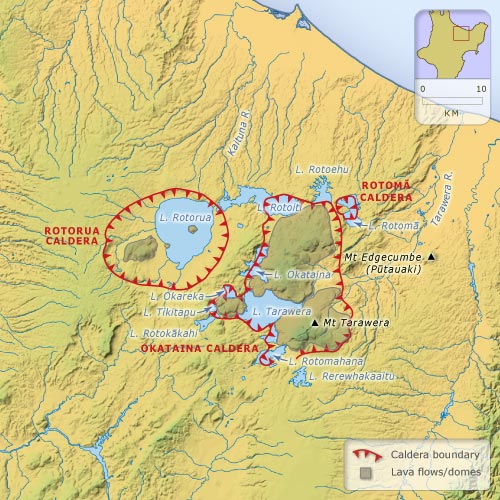
The Okataina caldera is an active volcano which has erupted six times in the last 10,000 years – most recently in 1886, when a giant fissure opened up along the lava dome that forms Mt Tarawera. The sequence of eruptions has built up the Haroharo and Tarawera mountains. By blocking drainage, they have also shaped the lakes of the caldera, notably Tarawera, Okataina and the eastern arm of Rotoiti. The neighbouring Rotorua and Rotomā calderas have only one lake apiece.
Te whakamahi i tēnei tūemi
Te Ara - The Encyclopedia of New Zealand
Source: based on information in J. M. Soons and M. J. Selby, eds, Landforms of New Zealand. Auckland: Longman Paul, p. 116.
This item has been provided for private study purposes (such as school projects, family and local history research) and any published reproduction (print or electronic) may infringe copyright law. It is the responsibility of the user of any material to obtain clearance from the copyright holder.
Comments
08 June 2020