




Attitudes
Attitudes to domestic violence between men and women in 19th-century New Zealand were shaped by ideas that settlers brought from Britain. Most believed that husbands were the head of the household and some thought this gave them the right, once part of English common law, to ‘correct’ their wives through physical punishment. Others rejected this, arguing that men were women’s ‘natural protectors’. Behind both views was a deep-seated belief that women were inferior to men. Consequently, women were legally, economically and socially disadvantaged. For example, husbands had the legal right to control their wives’ bodies and property. These attitudes were imposed on Māori society, in which violence towards women also occurred. Legal discrimination against women particularly affected Māori women in relationships with Pākehā men.
Prevalence
Family violence appears to have been widespread. Between 1850 and 1875, 11% of prosecutions for violence in Auckland were for domestic assaults. These prosecutions represented just a fraction of all assaults. Rape within marriage was not a criminal offence and was not reported.
Last resort
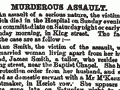
Many women endured serious, repeated violence – often with weapons including knives, bottles and hammers – before taking a prosecution. When Catherine Nicolson of Auckland prosecuted her husband John in 1855, she testified that he had beaten her ‘dozens of times’, once so badly that it was ‘more than nine days before I could show my face outside the door.’1
Taking a prosecution
Women usually had to lay a complaint of assault, rather than relying on police to prosecute. Once a woman had complained, her husband was summoned to appear before the police court. The case was heard and, if convicted, the man was required to keep the peace, fined or imprisoned. Few assault charges were referred on to the Supreme Court, and those deemed ‘trivial’ were dismissed.
Deterrents to legal action
Some women successfully prosecuted their husbands. However, the cost of taking proceedings, the possibility the case would be discharged, and the light sentences (three months’ imprisonment was typical) discouraged many from laying charges. Fear of ongoing violence was another deterrent. Women were sometimes assaulted by their husbands after a summons was issued.
There were other reasons for staying silent. Few married women had paid jobs, so most were financially dependent on their husbands. If a man was imprisoned, his wife had no income. Many women wanted to avoid the public shame of appearing in court and having the details published in the newspapers.
Alternatives
Women had some alternatives to legal action. One was to stay and tolerate the abuse. A few women sought shelter with friends or neighbours. Others entered new relationships. Some tried to survive alone, but this usually meant earning money, and job options for women were very limited and low-paid.
Is it right?
Women campaigning for the vote were acutely aware of the domestic issues many married women had to contend with. A pamphlet written by Kate Sheppard in 1892 asked: ‘Is it right that while the loafer, the gambler, the drunkard, and even the wife-beater has a vote, earnest, educated and refined women are denied it?’2
Divorce was expensive and difficult to obtain, making it an option only for the rich. Divorced people also risked becoming social outcasts, so divorce was rare.
Leaving a relationship was risky if a woman stayed in the same area. An estranged husband could hunt down and assault his wife, and until legal reforms occurred in stages between 1860 and 1882, he could still control his wife’s earnings and claim custody of their children. To avoid this, some women fled and changed their identity. For example, feminist Mary Ann Muller emigrated to New Zealand from England in 1850 to escape a cruel husband, presenting herself as a widow.
Temperance
Alcohol consumption was high in 19th-century New Zealand, and male drunkenness was often a factor in domestic violence. This was one reason women flocked to join temperance organisations. From 1885 until 1893 women’s groups, led by the Women’s Christian Temperance Union, campaigned for the vote, believing that this reform would lead to sweeping political and social change.