Kōrero: Hauraki tribes

Tara Te Irirangi

Image
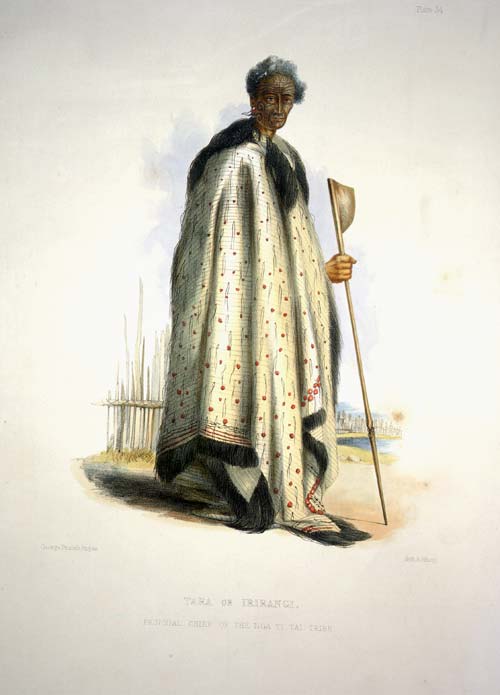
Tara Te Irirangi

He rangatira a Tara-te-irirangi nō Ngāi Tai ki te takiwā ki Te Wairoa, kei te taha tonga o Tāmaki-makaurau. I tāia tēnei whakaahua ōna e George French Angas i te tekau tau 1840. 

Te whakamahi i tēnei tūemi

Alexander Turnbull Library

Reference: PUBL-0014-34

by George French Angas

Permission of the Alexander Turnbull Library, National Library of New Zealand, Te Puna Mātauranga o Aotearoa, must be obtained before any re-use of this image.

Ngā whakaahua me ngā rauemi katoa o tēnei kōrero

Me pēnei te tohu i te whārang

Te Ahukaramū Charles Royal, Hauraki tribes – Ngāi Tai, Ngāti Pūkenga and Ngāti Rāhiri, Te Ara – the Encyclopedia of New Zealand, https://teara.govt.nz/mi/artwork/741/tara-te-irirangi (accessed 24 June 2026).

He kōrero nā Te Ahukaramū Charles Royal, i tāngia i te 4 March 2009, updated 3 March 2017.

Comments

shirley miller
18 September 2017
Kia ora Nat Green, Thank you for the kōrero about your tupuna Tara te Irirangi, i do appreciate it very much. I teach in Clover Park at Kia Aroha college and we recently have been researching kōrero about your tupuna but there isnt much available. I have been preparing booklets for my tamariki I teach as there whānau have lived here for 5-6 maybe more generations and they classify themselves as a hapu from this community of Ngai-Tai. It is important to me to teach our youth about the rich history of Ngai-Tai and of Tara-te-Irirangi. Where could I possibly source the actual kōrero tika for him? Please and Thank you. Kia ora.
Nat Green
04 September 2014
Kia Ora, Sandra. I am one of many descendants of Te Tara Te Irirangi, the tupuna shown above. Thank you for your concern about proper recognition for our ancestor's place in local history. However, Te Tara did not fight as a kupapa in the Land Wars, which occurred in the 1860s. Te Irirangi had already passed away during the early 1850s. According to his grandson and whangai child, Anaru Makiwhara (my great x3 grandfather), Te Irirangi died at the mouth of the Wairoa River (in Clevedon), having been taken there as his dying wish. The most prominent chief of the Ngai Tai/Ngati Tai people following Te Irirangi's death, and at the time of the conflicts in the Wairoa/Papakura district in 1863, was Hori Te Whetuki. Te Whetuki was in fact wrongfully arrested in 1863 on suspicion of involvement of a raid on a farm near Howick, but was later released without charge and lived on for many years, passing away at his home at Umupuia in 1882. Despite this incident, Te Whetuki along with Te Tara's son Honetana Te Irirangi had been regarded by local settlers and military in the Wairoa/Papakura district as "friendly" chiefs who sought to remain neutral and protect our people from the conflicts of the time. They were not "kupapa", as such - they did not fight against other Maori during the wars; they simply attempted to keep the peace by showing a friendly allegiance to the local Pakeha community. Neither Hori Te Whetuki nor Te Tara Te Irirangi died in prison. Perhaps you have confused these Ngai Tai chiefs with their close relative Ihaka Takaanini? Takaanini was a leading chief of Te Akitai of the Papakura district, for whom present-day Takanini is named. He was arrested during the Land Wars of 1863 as a suspected rebel, and did in fact die while imprisoned on Motuhurakina, alias Rakino Island. Hori Te Whetuki of Ngai Tai was with his old friend and cousin Takaanini when he died, and recorded the date as February 1864. Nga mihi Nat Green (Ngai Tai/Ngati Tai)
Sandra Gorter
03 October 2013
Tara Te Irirangi, for whom the major artery Irirangi Drive in Auckland is named, gave significant assistance to the early settlers of the Papakura district. He was Kupapa during the Land wars, his land was confiscated, and was sentenced to jail where I believe he died. A shameful acknowledgement of his support for the European settlers of this district. He deserves a mention in Te Ara.