Kōrero: Diverse religions

Whare Ra temple

Image
Whare Ra temple

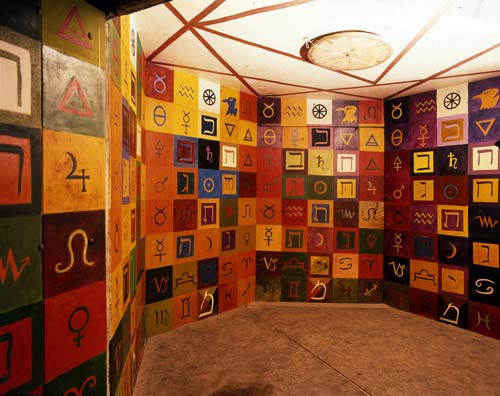
This windowless room, painted with mystical symbols and originally used for meditation, is part of Whare Ra ('House of the Sun'), a New Zealand temple for the Hermetic Order of the Golden Dawn. Whare Ra was built in 1915 in Havelock North, Hawke's Bay, to house the leader of the group, Robert Felkin, and his family. Felkin belonged to the Stella Matutina branch of the order, which combined a number of ancient magical traditions. Whare Ra closed in 1978 and in the 2000s the building was a private home.

Te whakamahi i tēnei tūemi

Art Deco Trust

by Peter Hallett

This item has been provided for private study purposes (such as school projects, family and local history research) and any published reproduction (print or electronic) may infringe copyright law. It is the responsibility of the user of any material to obtain clearance from the copyright holder.

Ngā whakaahua me ngā rauemi katoa o tēnei kōrero

Me pēnei te tohu i te whārang

Paul Morris, Diverse religions – Recent and new-age religious movements, Te Ara – the Encyclopedia of New Zealand, https://teara.govt.nz/mi/photograph/32285/whare-ra-temple (accessed 4 June 2026).

He kōrero nā Paul Morris, i tāngia i te 28 April 2011.

Comments

Leonard Stevens
03 September 2012
Suggest someone reads: "Islands of the Dawn" by Professor Robert Ellwood (University of Hawaii) who came to New Zealand in the late 1980. He studied the Whare Ra temple (which you have a brief mention of) and briefly also the Society of Guardians another magical society. The Whare Ra temple is unique in the world, as it was the last temple in existence belonging to the 'Order of the Golden Dawn' that was established by Westcott and MacGregor-Mathers. The traditions of the Whare Ra is continued by a few adepts, all of whom were students of adepts of the original old temple; such as Pat Zalewski, Jean de Cabalis, Nick Farrell and Tony Fuller. This is an important part of NZ alternative spirituality, and is well recognised internationally, yet hardly known in NZ. It may be worthwhile for someone to do some research into this.