

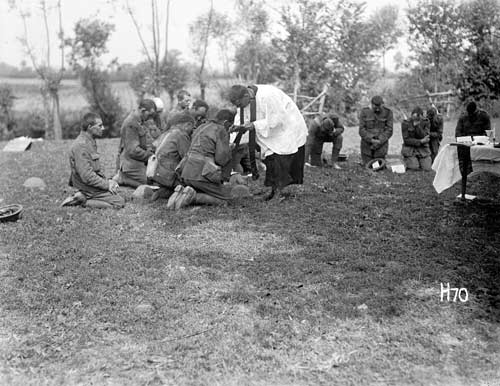
A Catholic priest offers holy communion to soldiers near the firing line on the Messines ridge in Belgium, 1917. For these soldiers it was important to participate in communion before going into battle. The communion ritual or eucharist entails eating bread (or a wafer) and drinking wine that symbolise the body and blood of Jesus Christ. For Christians this sacrament is one of the key rituals that connects human beings and God, and therefore is appropriate when someone is dying or anticipating death, as these soldiers did on the battle field during the First World War.
Te whakamahi i tēnei tūemi
Alexander Turnbull Library, Royal New Zealand Returned and Services' Association Collection
Reference: 1/2-012781-G
by Henry Armytage Sanders
Permission of the Alexander Turnbull Library, National Library of New Zealand, Te Puna Mātauranga o Aotearoa, must be obtained before any re-use of this image.
Comments
01 July 2024