

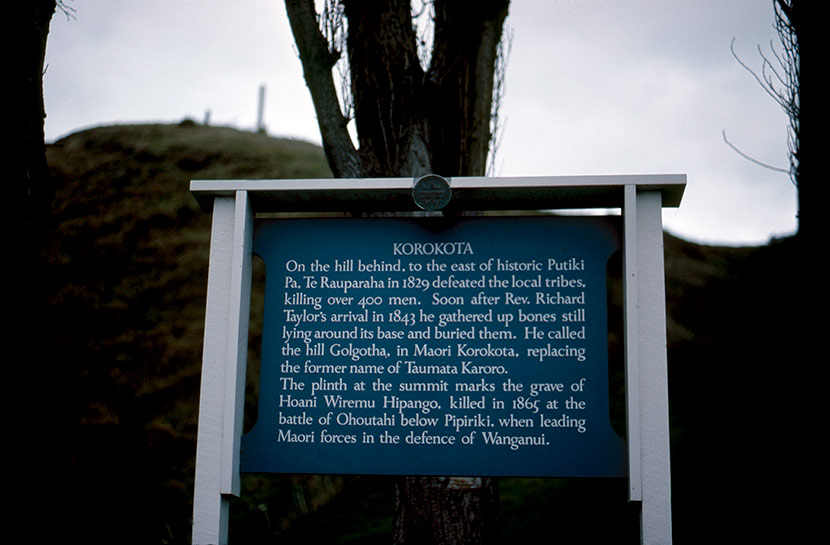
This sign marks a place near Whanganui which Anglican missionary Richard Taylor called Golgotha – meaning place of great suffering – after the hill on which Jesus Christ was crucified. The Māori transliteration is Korokota. Over 400 local Māori were killed there in an 1829 battle with a force led by Te Rauparaha. Despite such incidents, the death rate between 1810 and 1840 from musket warfare was small compared with that from introduced diseases.
Te whakamahi i tēnei tūemi
Te Ara – The Encyclopedia of New Zealand
by Jock Phillips
This item has been provided for private study purposes (such as school projects, family and local history research) and any published reproduction (print or electronic) may infringe copyright law. It is the responsibility of the user of any material to obtain clearance from the copyright holder.