Kōrero: Agricultural processing industries

Waimate North flour mill

Image
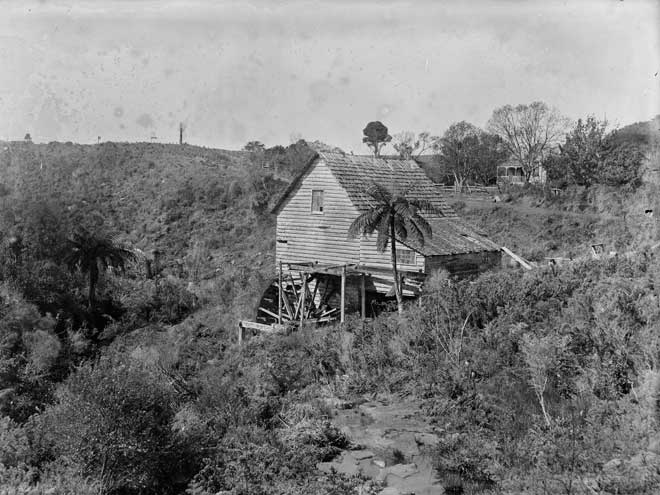
Waimate North flour mill

New Zealand’s first flour mill was built by the Church Missionary Society at its Waimate North mission station. This view of the mill, from about 1900, shows the waterwheel that powered the mill, driven by water from a small stream.

Te whakamahi i tēnei tūemi

Alexander Turnbull Library, Tesla Studios Collection (PAColl-3046)

Reference: 1/2-008459; G

Permission of the Alexander Turnbull Library, National Library of New Zealand, Te Puna Mātauranga o Aotearoa, must be obtained before any re-use of this image.

Ngā whakaahua me ngā rauemi katoa o tēnei kōrero

Me pēnei te tohu i te whārang

Jane Tolerton, Agricultural processing industries – Grain processing, Te Ara – the Encyclopedia of New Zealand, https://teara.govt.nz/mi/photograph/25173/waimate-north-flour-mill (accessed 4 June 2026).

He kōrero nā Jane Tolerton, i tāngia i te 6 April 2010.

Comments

Gavin Bedggood
19 July 2017
Great and detailed info. I have one suggested possible correction to one small point... the biscuit making factory I believe was NOT down stream of the Paramata mill, but at the same level as the mill with it's water wheel driven off another smaller stream and can be seen today as a swampy zone down the left hand side of Ash cottage.... I have seen an old photo of the mill in which the biscuit making water wheel can be seen poking out of the scrub in that position. As a side note I have the original receipt for the biscuit making machine from 1855 in my collection of Bedggood artefacts. Cost 200 pounds! Regards Gavin Bedggood, Paihia
Robyn McMullen
24 January 2014
Barry Lawrene, Can you please provide some evidence that "John McMullan" was the person who built the first Flour mill as I have Stewart McMullan a Millwright living in the area at the time. Stewart a few years later built mills at Rangiaowhai, Mercury Bay and Aotea (Beechamdale). Stewart was listed as a Millwright in 1828 working for Sir John Jamieson at Reagentsville. I would be interested to see the evidence as I thought John McMillin was a Blacksmith. Thanks Robyn
Barry Lawrence
23 August 2010
The photo above is NOT the first flour mill of Waimate North, but the second, built by John Bedggood, called the ‘Paremata Mill’being built in 1850, commencing operations in January 1852. Refer history below: The Mission Mill of Te Waimate. Waimate North, or Te Waimate, as it should rightly be called, situated at the road junction for Paihia 3.5 miles north of the town of Ohaeawai, this peaceful farming settlement has several important claims to distinction. Firstly, it was the scene of the first inland settlement of Europeans in New Zealand in 1830, and the site of the fourth Church of England Mission Station to be established in this country. Secondly, Waimate could fairly be described as the birthplace of systematic agricultural farming in the colony, the first flour mill being set up there in 1835 Kerikeri flourished and with wheat farming in mind, a road was built to Te Waimate. Kerikeri was at last to have its cherished water mill, akin to Marsden’s old mill at Parramatta, Australia, not to mention its own Stone Store-cum-granary, like the one at Parramatta Landing, and a boy’s school, but it was not to be. An ex-convict stonemason from Parramatta did build the Stone Store at Kerikeri Landing, but the mill was forsaken as the Kerikeri settlers supposedly recognised, in the very act of laying the mill’s foundations, a wheel stopping tidal factor. The mill went to Te Waimate and the school to Paihia. And so the story of the Flour mills of Te Waimate began. Wheat was one of the earliest crops. The chief Ruatara (of the Ngai-te-wake section of the Ngapuhi) had introduced the grain to New Zealand from Marsden’s farm at Parramatta, Australia. Ruatara is said to have baked the first loaf of bread made from New Zealand-grown wheat in June 1814. The Maori people were intrigued. Eighteen years later (1834), large amounts of wheat were growing on part of the 400 hectare block of land being developed into an agricultural centre for the introduction of European farming methods at the mission station under the direction of lay missionary, Richard Davis. Hand mills were proving too slow to grind the wheat into the flour needed at the mission station. However in 1830, when Marsden was visiting Te Waimate, he, and Mr and Mrs Clarke spent a happy afternoon building a working model of a simple water mill Marsden had seen in South America. This toy was the basis for the mill, the building of which started in 1833. In 1833, a Port Jackson millwright, John McMullin, was appointed to build a water powered flour mill, for which he received five shillings a day, plus rations. Working under the direction of Richard Davis and assisted by a group of Maori stalwarts, McMullin began the laborious and daunting task of building a dam across the stream, fashioning the waterwheel, driveshafts and gears in wood with the utmost precision. When Charles Darwin visited the mission station late in 1835, during the voyage of the Beagle, he was able to see the mill working as well as any mill in England. The following year Richard Davis proudly informed the Church Missionary Society that there was at least 12 months supply of flour at the station. Nearly 20 hectares of wheat were being grown and some 50,000 pounds of flour produced at Te Waimate. Mechanical industry had begun in New Zealand. On the 8th of August 1836, John Bedggood, who had answered an advertisement for the position of Wheelwright to service the agricultural implements at the station became the mission miller. In 1848 the mill was handed over to a company to operate, the Church Missionary Society having a third share and local farmers two-thirds. Some time in the mid-1850’s it fell into disuse and was eventually pulled down for the timber it contained, and now only traces of the mill dam remain to remind the visitor of New Zealand’s first manufactory. The Paremata Mill. During his time at Te Waimate, John Bedggood became interested flour milling and built a second mill, (the Paremata Mill) a mile or two down the road towards Kerikeri, it was built by Messrs Bedggood and Pugh in 1850. Called the ‘Paremata Mill’, it commenced operations in January 1852. This was operated under the name of ‘Bedggood and Sons’. Inspired by the number of whalers that called at the Bay Of Islands for provisions, John Bedggood decided that ships biscuits would also be a profitable commodity to manufacture. So he and his sons established a biscuit factory adjacent the flour mill in 1855. The biscuit factory was located several chains down stream below the flour mill. To power the biscuit factory, water was taken from the bottom of the flour mill water wheel to a second water wheel. The biscuit factory continued to export ship’s biscuits from Russell until the late 1850’s early 1860’s. When the local flour supply failed, an attempt was made to continue the operation by importing flour from the south, to manufacture biscuits from southern wheat, but freight costs spoilt success. For a time in the 1860’s the biscuit factory, much to the dislike of the missionaries was also a ‘grog’ shop. Ships biscuits were delivered to Russell and liquor was brought back to Te Waimate. John Bedggood was in business !! With the cost of running the farm at Te Waimate taking more capital than the mission could afford, the station reverted to a more religious emphasis and on the 15th April 1853, Bedggood and his son, John Thomas Bedggood leased (bought ?) the society’s original mill for seven years from Robert Vidal, Auckland agent to the Church Missionary Society. John Bedggood and sons would operate both mills. That is the last we know of the original Mission mill. Timber from first mill (Mission mill) was eventually used to build ‘Roseburn’ the home of Mr James Bedggood. However the decline of wheat growing in preference to Gum Digging, coupled with disease in the wheat crop of the Bay of Islands, meant that the wheels of the Paremata mill stopped grinding wheat about the early 1860’s. John Bedggood then became a local storekeeper. In the late 1860’s, Messrs Alexander, Atkinson and Cook purchased the mill and put it in running order again, although no wheat was ever ground. The Partnership: Alexander, Atkinson & Cook. When Alfred Alexander arrived in New Zealand, a single man, on the 20th November 1861, he promptly sold his 40 acre grant for ₤5 without even inquiring where it was located. Being a flour miller by trade, he took employment with Thornton, Smith and Firth in an old mill which stood on a site later occupied by Smeeton’s buildings in Auckland. He only worked here for a short time before travelling to the Coromandel area and the Kauri sawmill of Kennedy’s Bay. Alfred married Miss Mary Ann Kenyon, with whom he had travelled from England on the ‘Black Eagle’, in the old Saint Mathews church (Hobson Street, Auckland) on the 18th February 1864. There were three Kenyon sisters who travelled to New Zealand, Harriet and her brother James, arriving earlier from England on 30th April 1855, on the 460 ton barque ‘Cornubia’. Mary Ann and Rose Ann Kenyon travelled to New Zealand later on the ‘Black Eagle’ with Alfred in 1861. Harriet Kenyon married Fredrick Atkinson, Rose Ann Kenyon married William Cook, and Mary Ann married Alfred Alexander. The three husbands journeyed to Waimate North and went into partnership in the Paremata Mill, and also leased, 133 acres from the Bedggood family. There were two houses on the property, so the Cook’s lived in the mill. William being a builder, built a third house for Alfred, constructing it from the timber of the old biscuit factory. It was known as the “Ash Tree Cottage” (some stories say “Ash Grove Cottage”), there being a large Ash tree nearby. It is believed that Ash Tree Cottage was built approximately 1865 after the demise of the biscuit factory. The partnership created a great deal of interest, it was said that……… Alexander had the “know how” Atkinson “had the land” & Cook “had the money” They restored the Bedggood’s Paremata Flour Mill which had not operated for several years – However no wheat was ever ground in the restored mill. Frederick Atkinson was a storekeeper, and kept a shop in front of his house opposite the mill. Frederick ran the General Store in the area of Waimate North that came to be known as ‘Cooksville’. It was a very profitable business. From the flourmill Alfred moved to Waimate North’s first general store, operating it with his brothers-in-law Messrs Fred Atkinson and William Cook. However, for Alfred, the years ahead were tragic. Mary Ann lost her first child, Alfred B (14 months) in 1866. Alfred Kenyon, their second born, was born in Auckland on 8th June 1868. On the 24th October 1870, Mary Ann gave birth to premature twins, and it is sad to relate that they all died. The nearest medical help in those days was Kawakawa, a great distance at the time. The twins were buried (reportedly) on the farm. Sadly, the custom of the time being, ‘unbaptised’ children could not be buried in a church cemetery. For Alfred, this latest incident was most unsettling and he returned to Auckland and joined Mr. Robert Lamb (snr) in the flour milling business. The company of Alexander, Atkinson & Cook seems to have come to an end about 1872 or 73.This was when Alfred returned to Auckland. It was then carried on as Atkinson & Cook, then Cook was cast off and Atkinson ruled supreme. The derelict mill building finally fell down on a still night in 1959, and the machinery was reclaimed and is stored at the Te Waimate Mission House store.