

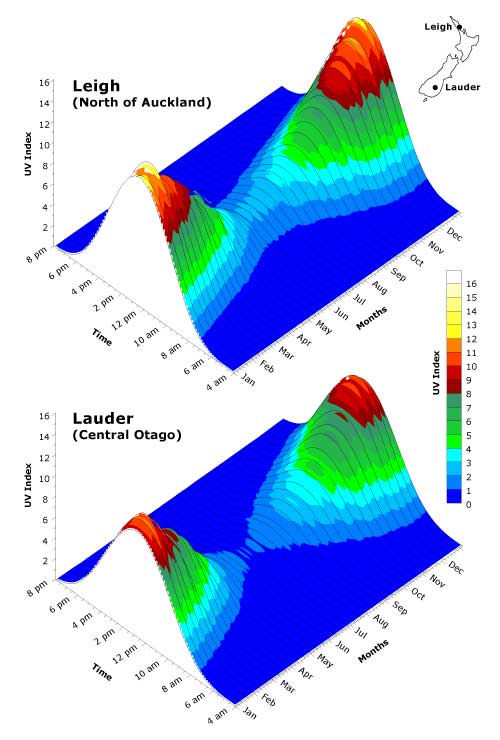
These graphs show the daily changes in ultraviolet (UV) light concentrations in the north at Leigh, near Auckland, and the south at Lauder in Central Otago. The measurements were taken over a one-year period. Red and green indicate higher levels, while lower levels are blue. It is immediately obvious that early afternoon summer UV intensities are the highest, while in midwinter they are at their lowest. Maximum UV levels at Leigh are higher than those at Lauder. This is because the summer sun is at a lower angle in southern New Zealand: the rays travel through more of the earth’s atmosphere, which filters out more UV radiation before they reach the earth's surface.
Te whakamahi i tēnei tūemi
NIWA – National Institute of Water and Atmospheric Research
This item has been provided for private study purposes (such as school projects, family and local history research) and any published reproduction (print or electronic) may infringe copyright law. It is the responsibility of the user of any material to obtain clearance from the copyright holder.
Comments
21 January 2011