

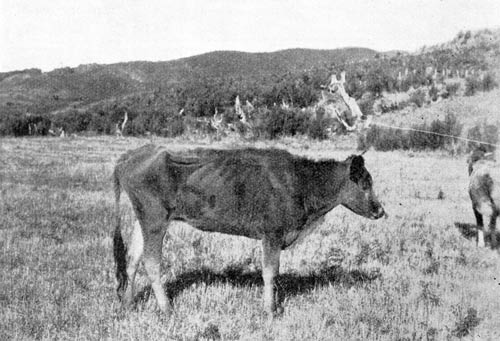
This photograph illustrated a 1932 report on bush sickness. Although farm animals had adequate food, the deficiency of trace elements in the soil caused a wasting disease that made them look as if they were starving.
Although bush sickness had been studied since the beginning of the 20th century, in the 1920s there was debate about what caused it. A decade later the cause was found to be a deficiency in the trace element cobalt. It was soon cured by adding small amounts of cobalt to fertiliser or stock food.
Download the document to read extracts from a letter written in 1923 by Te Puke veterinarian A. A. MacFarlane, who describes bush sickness (14 KB).
Te whakamahi i tēnei tūemi
Te Ara – The Encyclopedia of New Zealand
Reference: L. I. Grange and N. H. Taylor, 'The distribution and field characteristics of bush-sick soils.' In Bush sickness, 21-35. DSIR Bulletin 32. Wellington: W. A. G. Skinner, Govt. Printer, 1932, p. 30
This item has been provided for private study purposes (such as school projects, family and local history research) and any published reproduction (print or electronic) may infringe copyright law. It is the responsibility of the user of any material to obtain clearance from the copyright holder.