Kōrero: The voyage out

A daughter of Neptune

Image
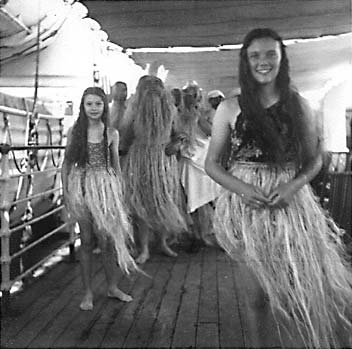
Young women in grass skirts on ship
When ships crossed the equator, special celebrations were devised for first-timers ‘crossing the line’. Pictured is Beryl Tuppen (left) dressed as one of Neptune’s daughters, onboard the steamship Captain Cook in 1952. Other passengers dressed up in a variety of characters – Captain Cook, Carmen Miranda and Mae West among others. King Neptune can be also seen in the background directing the proceedings.

Contributed by Beryl Tuppen of Auckland.

The day before sailing, getting notification of a delay due to the New Zealand waterfront strike and waiting a year before we left the UK.

The excitement of it all, together with the sadness of knowing we would never see relatives or our homeland ever again.

The packed decks as everyone sat about in the cold sunshine on canvas deckchairs. There was never a spare seat for a gangly youngster. I prowled, while they read, knitted, sewed or chatted.

Plates and bowls sliding up and down the meal tables in the Bay of Biscay, while most passengers took to their bunks. The stuffy cabin. The nauseating smell and the porthole shut to keep the waves out.

Wearing my first pair of longs, blue wool flares, and proudly standing at the prow imagining I was on a pirate ship.

Learning from the sailors how to whistle.

The awnings going up and the kiddies’ paddling pool (a canvas sheet) being filled when we got into the tropics.

The gunfire at Curacao, and because of local fighting having to rush back and stay on board in stifling heat till the next day. The huge branch of bananas the men carried back on a pole.

A certain overpowering smell of crude oil and baking coffee beans.

The electric mules pulling our ship through the locks at the Panama Canal and my father steadfastly recording it on film.

Being a mermaid, daughter of King Neptune, and the fun of crossing the meridian line, Captain Cook, Mae West, Carmen Miranda and all.

Coming second in a children’s fancy dress, dressed as ‘navigation’.

Bartering with boat-loads from Pitcairn Island.

Coming into the Wellington Heads in a vicious southerly swell. Anchoring in the harbour overnight, then the magic of the brightly coloured houses perched on the hills on a sparkling sunny winter’s morning.

Not getting our clothes and household goods for months due to the strike.

Te whakamahi i tēnei tūemi

Private collection

This item has been provided for private study purposes (such as school projects, family and local history research) and any published reproduction (print or electronic) may infringe copyright law. It is the responsibility of the user of any material to obtain clearance from the copyright holder.

Ngā whakaahua me ngā rauemi katoa o tēnei kōrero

Me pēnei te tohu i te whārang

John Wilson, The voyage out – Personal accounts: 1900–1959, Te Ara – the Encyclopedia of New Zealand, https://teara.govt.nz/mi/community-contribution/4317/a-daughter-of-neptune (accessed 4 June 2026).

He kōrero nā John Wilson, i tāngia i te 4 March 2009.

Comments

Carol Butterfield
09 April 2020
I was 14 when I came out on the TSS Captain Cook at Easter 1958. Have loved reading these stories. Anyone else out there in NZ who came out on the same voyage by any chance?
Gary Westwood
24 December 2018
I was eight years old when we sailed from Southampton in June, 1953. Nearly 1100 passengers plus crew packed into a ship just one sixth the size of today's medium sized cruise ship. I shared a cabin with my father and four other men and my mother was in a four berth with three women. The creature comforts were at best spartan. Despite the sleeping arrangements there was an air immense anticipation as the ship sailed down the English Channel and out into the Atlantic for the five week voyage to Wellington. Somewhere between Southampton and Curacao a passenger developed polio which meant that the ship was quarantined in Curacao and again in Panama which meant that no passengers or crew were allowed ashore between England and NZ. A very long voyage indeed. The engineers built a makeshift iron lung for the polio patient and she survived the voyage in isolation. Having been brought up in an era of stringent food rationing I recall the abundance of food on board and the smell of fresh bread baking brings back instant memories of 'Captain Cook' - as does the smell of fuel oil. We arrived in Wellington in July to a clear blue sky and mirror-like waters and I recall snowclad mountains on the horizon which I suppose were the Kaikouras as we made our way up Cook Strait. From Wellington we were placed straight on to a special train for the overnight journey to Auckland which turned into a 24 hour ordeal as the train was delayed by floodwaters in the Waikato. One very special memory was breakfast served at very short notice in a railway facility in Mercer as by then we were all starving. It was an immense Kiwi breakfast with bacon, eggs, sausages, chops and toast and I still recall my father saying that we had truly arrived in the land of milk and honey. My parents never returned to the UK and I'm a very proud Kiwi as are my NZ-born children. I can only thank my lucky stars that my parents had the courage to pull up their roots, forever farewell their families and sail for NZ on 'Captain Cook'.
Craig Bonner
23 May 2015
We came to NZ on the Captain Cook in early 1953. I was 5 with two brothers, 6 and 3. I was a bit perturbed making way out of Glasgow because there were cows in the paddocks on either side of the ship and I had been expecting sea. The next morning it was quite rough and I sat on the floor in our cabin and asked my Dad to make it stop rocking. He picked me up and took me on deck to see the water. I can remember seeing the movie Jack and the beanstalk on the screen set up on the deck. I cried when a black beggar asked for money in Curacao. The next day Mum sat us down and explained that in the country we were going to there were "marys" and they looked a bit like the people at Curacao. One of the great memories I have is of drinking lemonade for the first time and being fascinated with the ice tinkling in the glass.
Michael Townsend
26 August 2010
I was 6 when my family emigratated from Glasgow (where I remember huge wheels on the train from London) to New Zealand via the SS Captain Cook. I have a photo of my family and I surrounded by fruit, perhaps at Curacao, dated February 1952. Even today the smell of a ship's engine room instantly evokes the memory of the engine-cum-kitchen smell of the Captain Cook. I remember having to overcome a migraine headache and a very hot day to go up on deck to see the little trains as we passed through the Panama Canal. My mother tells the story of she and my father walking along one of the decks, while passing through the tropics, under the shade of canvas hung from the deck above out to the railing. She was shocked to see the canvas shudder as children jumped into it from the deck above, risking rolling to the edge and plunging into the sea. She told my father to get up and tell the children of the danger. He clambered up the outside railing holding on to a support pole and peered over the top of the canvas only to find it was my sister (aged 4) and I doing the jumping. I have no recollection of what happened next. I have no memory of arrival in New Zealand or how we got to Christchurch, or to a lonely house about a mile from the town of Woodend where we had to walk with a billy each day to a local farm to fetch fresh milk. But as I grew up I began to realise why my father felt dispossessed of a career in medicine (because of his role in the war) and of the culture he knew as a city-boy from London.