Kōrero: Poisonous plants and fungi

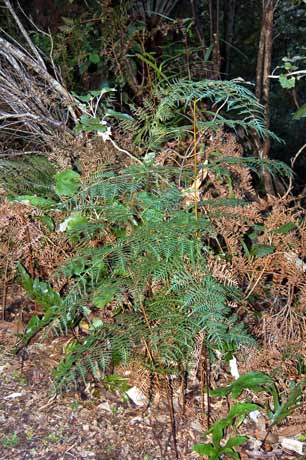
Bracken fern

Image
Bracken fern

Bracken is a common fern found in open sites throughout New Zealand. Cattle and horses grazing on young bracken fronds are susceptible to poisoning. Cattle develop internal bleeding and horses lose co-ordination. The creeping rhizome (underground stem) was an important food for Māori, who harvested it in late winter. They pounded roasted rhizomes to extract a starchy flour. The young shoots were also eaten. It is now known that bracken contains chemicals that cause cancer, and should not be eaten at all.

Te whakamahi i tēnei tūemi

Private collection

by Iona Wassilieff

This item has been provided for private study purposes (such as school projects, family and local history research) and any published reproduction (print or electronic) may infringe copyright law. It is the responsibility of the user of any material to obtain clearance from the copyright holder.

Ngā whakaahua me ngā rauemi katoa o tēnei kōrero

Me pēnei te tohu i te whārang

Maggy Wassilieff, Poisonous plants and fungi – Poisonous plants used for food, Te Ara – the Encyclopedia of New Zealand, https://teara.govt.nz/mi/photograph/9778/bracken-fern (accessed 5 June 2026).

He kōrero nā Maggy Wassilieff, i tāngia i te 1 March 2009.

Comments

Alice
19 May 2022
The suspected carcinogen contained in bracken shoots is ptaquiloside, which is a volatile compound that reacts in alkaline environments to form the cancer-causing substance dienone. This is why ruminants are so strongly affected by it - their stomachs are alkaline enough for this reaction to take place. However, ptaquiloside is also water soluble and notoriously volatile at room temperature, so the common human methods for preparing bracken shoots (soaking in cool water, steaming, then pan frying) renders the bracken safe to eat. Habitual consumption (talking year round for decades) has been tenuously linked to increased rates of stomach and throat cancer in east asia, but the occasional spring treat isn't going to kill you so long as you prepare it right
Ben
31 May 2012
In horses, the enzyme thyaminase leads to a thiamine (vitamin B1) deficiency. Symptoms can include incoordination, muscle tremors, pronounced heartbeat after mild exercise. Extreme symptoms include convulsions and death. Treatment is by intravenous administration of thiamine.