Kōrero: Petrels

Westland petrels

Image
Westland petrels

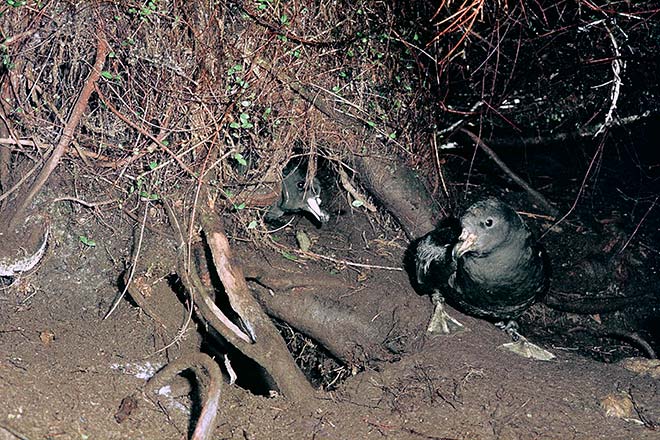
Like other Procellaria petrels, these are sturdy-looking birds. Westland petrels breed at a hillside colony near Punakaiki on the West Coast, and are one of the few petrel species still breeding on the mainland. As they are among the largest burrowing petrels, they are less vulnerable to predation in the nest than smaller petrels, but are still vulnerable to larger predators such as dogs and, to a lesser degree, cats, weka, large rats and mustelids.

Westland petrels were unknown to science in 1945, when the pupils of the small country school at Barrytown, Westland, wrote to Robert Falla, director of the Canterbury Museum in Christchurch, in response to his radio broadcast about muttonbirds. Their claim that the local ‘muttonbirds’ laid their eggs in May, not in November, led Falla to realise that these birds were different. The children showed him the colony, and Falla concluded it was a new subspecies of the black petrel. It was subsequently considered a separate species.

Te whakamahi i tēnei tūemi

Department of Conservation

Reference: 10031026

by Rod Morris

This item has been provided for private study purposes (such as school projects, family and local history research) and any published reproduction (print or electronic) may infringe copyright law. It is the responsibility of the user of any material to obtain clearance from the copyright holder.

Ngā whakaahua me ngā rauemi katoa o tēnei kōrero

Me pēnei te tohu i te whārang

Kerry-Jayne Wilson, Petrels – Shearwaters, Procellaria and fulmarine petrels, Te Ara – the Encyclopedia of New Zealand, https://teara.govt.nz/mi/photograph/8586/westland-petrels (accessed 4 June 2026).

He kōrero nā Kerry-Jayne Wilson, i tāngia i te 2 March 2009.

Comments

Te Ara
17 October 2013
Thanks Bruce. Point taken, and we have adjusted the caption.
Bruce Stuart-Menteath
11 October 2013
Regarding the comment that suggests that because Westland Petrels "... are among the largest burrowing petrels, they are less vulnerable to predation in the nest than smaller petrels" petrels." This is a common misconception that has been widely repeated, but is highly misleading and may be the cause for some complacency about this species vulnerability to predation and the need for every effort to protect it from human induced impacts. The reality is that predation by cats, dogs and stoats are of great concern and impact on adults as well as young Westland petrels. I operate Paparoa Nature Tours and conduct public tours to the Westland Petrel colony. In 2000 there was a major problem when many adult Westland petrels were killed by a couple of local dogs. At least 12 adult Westland Petrels were killed at the sub-colony on our property on that occasion, and it is highly likely that dozens more were killed in the wider colony area administered by DOC. Unfortunately most of the breeding grounds is not monitored because DOC is so underfunded. Petrels are slow breeders and it took 10 years for the sub-colony on our property to recover from the attack. It is evident that even occasional predation problems can have major and lasting impacts on the survival of this species. I look forward to seeing websites like yours painting the true picture of the threats that mammal predators pose to the Westland petrel. Regards, Bruce Stuart-Menteath