Kōrero: Whales

Removing jawbones

Image
Removing jawbones

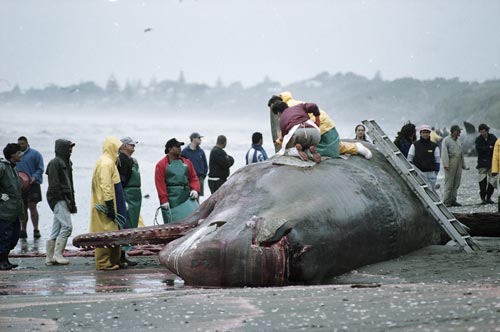
Māori traditionally treasured stranded whales for their jawbones, which were used for carving. When three sperm whales beached and died at Paekakariki in March 1996, Māori from the region removed the jawbones from two of the three. The third whale was washed out to sea.

Te whakamahi i tēnei tūemi

Alexander Turnbull Library, Dominion Post Collection (PA-Group-00685)

Reference: EP/1996/0832/9A

by Phil Reid

Permission of the Alexander Turnbull Library, National Library of New Zealand, Te Puna Mātauranga o Aotearoa, must be obtained before any re-use of this image.

Ngā whakaahua me ngā rauemi katoa o tēnei kōrero

Me pēnei te tohu i te whārang

Gerard Hutching, Whales – Strandings: whales and dolphins, Te Ara – the Encyclopedia of New Zealand, https://teara.govt.nz/mi/photograph/7111/removing-jawbones (accessed 4 June 2026).

He kōrero nā Gerard Hutching, i tāngia i te 2 March 2009.

Comments

Nani Flowers
27 October 2011
We think that to prevent whales from stranding themselves we could make the beaches with high stranding rates slope less. Because the website says that most beaches that have high slopes are 'whale traps' because the whales can easily swim and strand themselves or the current could push them towards the beach.
koro
27 October 2011
That is just cruelty to animals!
Nani Flowers
27 October 2011
We think the best way to keep whales from stranding themselves is to install a sonar reciever system a mile off of shore to hear whales calls and how close they are to shore. If their call is close, they could send a team out there to help the whales go back out to the ocean.