Kōrero: Jazz and dance bands

Dixieland Internationals

Image
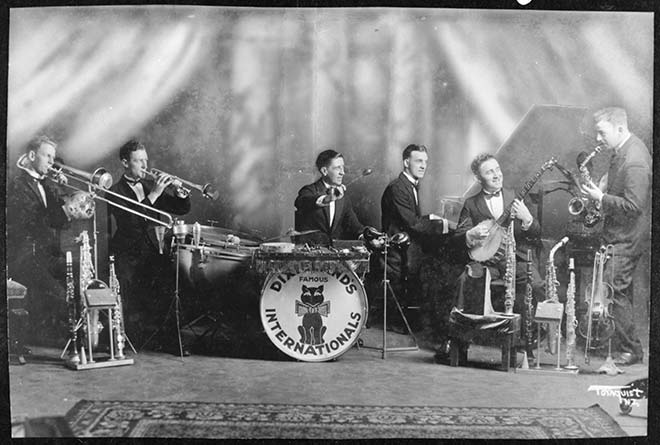
Dixieland Internationals

Despite its name, the Dixieland Internationals jazz band was composed mainly of local musicians. From the late 1920s it was the house band for the large and luxurious Dixieland Cabaret in Point Chevalier, Auckland. This photo is from around the 1940s. 

Te whakamahi i tēnei tūemi

Alexander Turnbull Library, Dennis Owen Huggard Collection (PA-Group-00439)

Reference: 35mm-90428-9-F

Permission of the Alexander Turnbull Library, National Library of New Zealand, Te Puna Mātauranga o Aotearoa, must be obtained before any re-use of this image.

Ngā whakaahua me ngā rauemi katoa o tēnei kōrero

Me pēnei te tohu i te whārang

Chris Bourke, Jazz and dance bands – Early New Zealand jazz bands, Te Ara – the Encyclopedia of New Zealand, https://teara.govt.nz/mi/photograph/44943/dixieland-internationals (accessed 4 June 2026).

He kōrero nā Chris Bourke, i tāngia i te 8 April 2014.

Comments

Brett Lowe
22 January 2024
This photo dates from 1925 at the opening of the new Dixieland Cabaret which relocated from Queen Street to Pt Chevalier in that year. The cabaret burnt down in the 1930s and returned to a different part of the same building it had previously inhabited. The musicians include Australian saxophonist Mick Atlas who led the band briefly in 1925 and was employed for the opening of the new Cabaret. It also includes Auckland pianist, Clyde Howley, trumpeter Vern Wilson and banjoist Harold Youd/Yude (?). The trombonist may be Norm Ganley, who later (about 1929-34) ran his own band also called the Internationals. The band at the Dixieland was later run by Clyde Howley, and his future wife was sometimes featured as a dancer at the cabaret. She was well remembered in Auckland as an expert at dancing the Hula amongst other things. About 1928, Harry Nielsen joined the band as a Sousaphone player and by about 1930 was leading the band. During the 1920s, the Dixieland Internationals (as they were known) were considered the preeminent dance band in Auckland and played most of the Government House Balls. The Dixieland refers not to the music they played, but to the location - the Dixieland Cabaret. The term Dixieland used to refer to a style of music only becoming commonly used in the late 1940s.