Kōrero: Subantarctic islands

Stilbocarpa polaris

Image
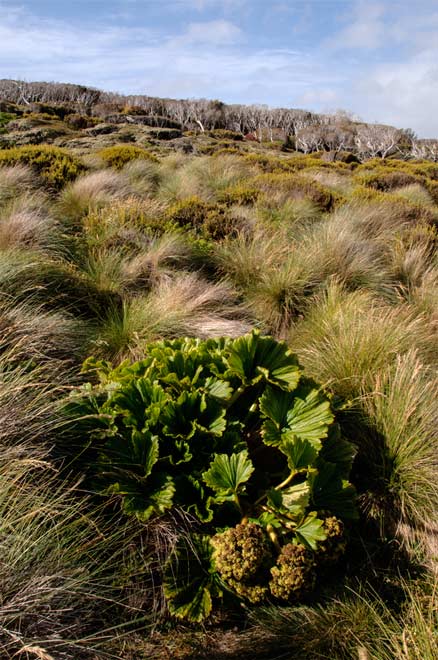
<em>Stilbocarpa polaris</em>

With its large rhubarb-like leaves, Stilbocarpa polaris was known as Macquarie Island cabbage, because it was eaten by sealers to ward off scurvy. It was also a staple food for castaways on the Auckland Islands.

Te whakamahi i tēnei tūemi

acpalmer photography

by Andy Palmer

This item has been provided for private study purposes (such as school projects, family and local history research) and any published reproduction (print or electronic) may infringe copyright law. It is the responsibility of the user of any material to obtain clearance from the copyright holder.

Ngā whakaahua me ngā rauemi katoa o tēnei kōrero

Me pēnei te tohu i te whārang

Jock Phillips, Subantarctic islands – Land and plants, Te Ara – the Encyclopedia of New Zealand, https://teara.govt.nz/mi/photograph/38505/stilbocarpa-polaris (accessed 4 June 2026).

He kōrero nā Jock Phillips, i tāngia i te 28 November 2012.

Comments

Ed
22 June 2016
"And I'm wondering if anyone has considered utilizing the plants natural quality for this purpose of whitening teeth rather than the sometimes toxic or harmful chemicals within other products that are manufactured today? " Gregory, I had the exact same thought! I typed in Stilbocarpa and came across this website. It doesn't seem to me that anyone else out there uses this plant for natural teeth bleaching. I wish I could get my hands on one live plant and see if it really works.
Gregory Milligan
12 February 2015
In the book "Island of The Lost", written by Joan Druett, published in 2007, she tells the castaway story of two ships, the "Grafton" and the "Invercauld" on Auckland Island. Her book is taken from the accounts of Captain Musgrave of the Grafton and either Captain George Delgarno or seaman Robert Holding of the Invercauld. This a well written account of these two shipwrecks. But what I found most intrigueing was the the information on the plants each of the groups found edible on the island and most likely helped to save their lives, specifically the Stilbocarpa polaris. It is written that the plant has a high content of a starch-storing sugary rhizome which has the side effect of bleaching the teeth white. And I'm wondering if anyone has considered utilizing the plants natural quality for this purpose of whitening teeth rather than the sometimes toxic or harmful chemicals within other products that are manufactured today? Worth looking into!