Kōrero: Family welfare

Caversham Industrial School

Image
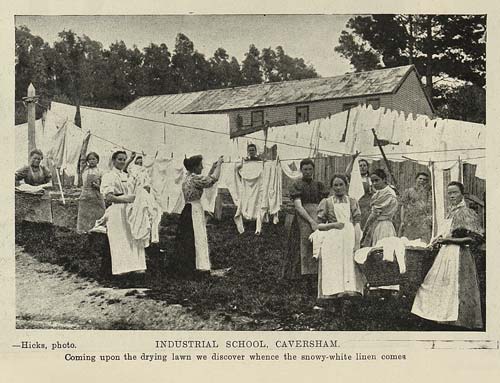
Caversham Industrial School

Dunedin’ Caversham Industrial School was one of many institutions established in New Zealand in the late 19th century to house and train children whose parents could not care for them. Some of the children and adolescents in industrial schools were born outside marriage. Others had lost a parent or had parents who were seen as too immoral or drunk to look after them. The focus was on physical care, schooling and training for useful work. For girls this often meant training to be good housewives or domestic servants through doing washing and other domestic work.

Te whakamahi i tēnei tūemi

Toitū Otago Settlers Museum

Reference: <em>Otago Witness</em>, 27 March 1901, page 39

Permission of Toitū Otago Settlers Museum must be obtained before any re-use of this image.

Ngā whakaahua me ngā rauemi katoa o tēnei kōrero

Me pēnei te tohu i te whārang

Maureen Baker rāua ko Rosemary Du Plessis, Family welfare – Mothers and children – 1800s to 1917, Te Ara – the Encyclopedia of New Zealand, https://teara.govt.nz/mi/photograph/26076/caversham-industrial-school (accessed 4 June 2026).

He kōrero nā Maureen Baker rāua ko Rosemary Du Plessis, i tāngia i te 31 March 2011.

Comments

Murray McKenzie
25 July 2024
I am very interested in this institution. My g grandmother (then Mary Johnston) was admitted after her parents had both died in the Waiwera area. I have confirmed Mary's entry to the Caversham Industrial School as below. William, Catherine and Mary were admitted to the Caversham Industrial School in 1876 as per the following Otago Daily Times newspaper report: Orphan Children – William Johnston (age 11), Catherine (age 9) and Mary (age 7) three well-dressed children were brought before the Court by their uncle, John Bell, under the Neglected and Criminal Children Act. – Applicant stated that their parents were dead and though their father had left some considerable property in the hand of trustees witness did not know what become of it. He had seven children of his own to support and had maintained these little ones as long as he could. - The Bench committed them each to the Caversham Industrial School for 5 years. I have spent a lot of time reconstructing the lives of Mary and her 6 siblings. I don't have a lot on what her life was like at the Caversham school.