Kōrero: Hawke’s Bay region

Repudiation movement

Image
Repudiation movement
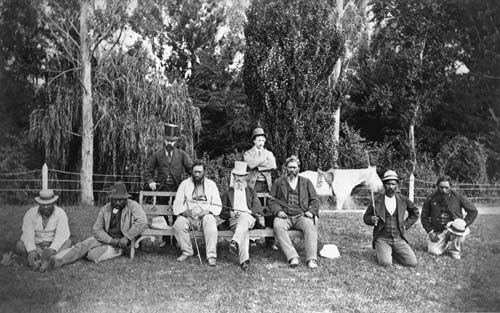
Discontent among Māori over land sales eventually led to the Hawke’s Bay-based repudiation movement, which rejected all sales and leases. Though runholder Henry Russell (shown here on seat, centre, with leading members of the movement) had purchased land under much the same circumstances as other runholders, he was concerned about the welfare of Māori and believed they should retain land and power over their own affairs. This led him to ally himself with the movement. He was also engaged in serious disputes with fellow runholders, so his alliance was politically strategic as well as philanthropic.

Te whakamahi i tēnei tūemi

Alexander Turnbull Library

Reference: 1/2-038687; F

Permission of the Alexander Turnbull Library, National Library of New Zealand, Te Puna Mātauranga o Aotearoa, must be obtained before any re-use of this image.

Ngā whakaahua me ngā rauemi katoa o tēnei kōrero

Me pēnei te tohu i te whārang

Kerryn Pollock, Hawke’s Bay region – European settlement, Te Ara – the Encyclopedia of New Zealand, https://teara.govt.nz/mi/photograph/23899/repudiation-movement (accessed 4 June 2026).

He kōrero nā Kerryn Pollock, i tāngia i te 22 January 2010, updated 1 July 2015.

Comments

Keith Rees
01 January 2014
Do you have the names of any of these gentleman, in particular, the two at the back? The one on the right looks like one of William Lee Rees' sons, and the guy on the right is not totally unlike Wm Lee Rees himself. This is what I have said in The Rees Pocock Connection, which is not being published. 1877 – 1878 Napier The Rees family, including Lottie Staite and Alfred Pocock moved to Napier on the east coast of the North Island of New Zealand. In 1878, William Lee Rees took over the Napier legal practice of John Sheehan, Grey's native minister. He then carried the Repudiation movement from Hawke's Bay to Poverty Bay by shifting to Gisborne (1879) and serving as counsel to Ngati Porou in their claims against the questionable land purchases of Captain George Read. His legal advocacy and strong rhetorical outbursts won him the firm alliance of Maori leaders such as Wi Pere of Rongowhakaata and Te Aitanga-a-Mahaki. [Discontent among Māori over land sales eventually led to the Hawke’s Bay-based repudiation movement, which rejected all sales and leases. Though runholder Henry Russell had purchased land under much the same circumstances as other runholders, he was concerned about the welfare of Māori and believed they should retain land and power over their own affairs. This led him to ally himself with the movement. He was also engaged in serious disputes with fellow runholders, so his alliance was politically strategic as well as philanthropic]. Source: http://www.teara.govt.nz/en/photograph/23899/repudiation-movement Rees and Wi Pere formed a company to side-step the litigation caused by the complex native land laws and make more Maori land available for settlement. As a way of ensuring that Maori owners received a fair price and that sufficient land was left to ensure the survival of Maori farming, Rees persuaded owners to allow himself and Wi Pere to act as trustees with absolute power to deal with lands as they saw fit, provided that they worked in constant communication with committees elected to represent the owners. In 1879, the Rees family was joined by Victor Grace Day from London. Victor was the son of William and Elizabeth Day, William Lee Rees’ eldest sister. Her was articled to his uncle and later admitted to the Bar and became a partner in the law firm. Regards, Keith Rees Australia