

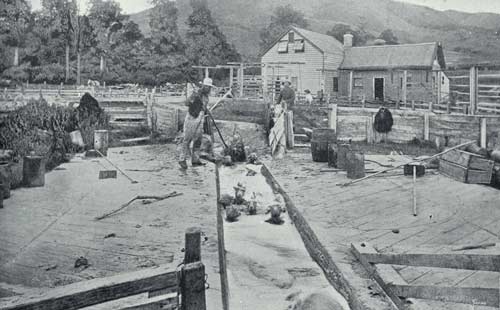
Sheep scab was a serious stock health problem from the late 1840s. The disease is caused by the mite Psoroptes ovis, which lives in the animal’s skin. An ordinance passed in 1849 required the inspection of flocks. Sheep were treated by dipping in a solution of boiled tobacco water, sometimes with salt, saltpetre, sulfur or arsenic added. Scab was largely under control by the 1880s – mainly thanks to fencing, which allowed farmers to keep their stock separate from infected flocks. These sheep are being dipped at Ōrari Gorge Station in South Canterbury, around 1900.
Te whakamahi i tēnei tūemi
Reference: PhotoCD 14, IMG0067
This item has been provided for private study purposes (such as school projects, family and local history research) and any published reproduction (print or electronic) may infringe copyright law. It is the responsibility of the user of any material to obtain clearance from the copyright holder.