Kōrero: Bush trams and other log transport

Goodbye to the bush

Image
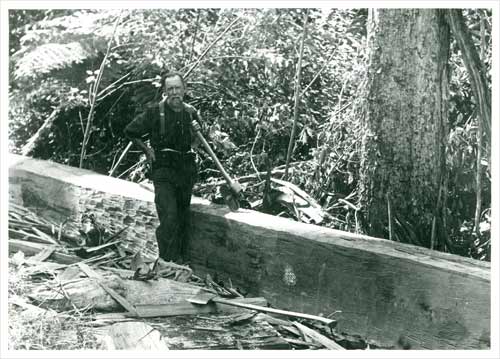
Man standing next to slab of cut timber in the bush
Frank Ward squares a stringer (a weight-holding beam for a bridge), over which bush trams pass. As his daughter Elizabeth explains, Frank spent his working life in the bush, and wrote a poem about it just before he died.

Born in Manchester, England in 1873, Frank Ward emigrated to New Zealand with his family in 1880. He grew up on a bush farm in Ruapuke, near Raglan, and as a teenager headed south to work in timber mills. He learned to survey, and to build bush bridges. The rest of his life was spent working for sawmilling companies, especially Taringamotu Totara Sawmills, who operated in the rugged King Country around Taumarunui.

Frank was a small man, seemingly frail, but his strength in wielding an axe was phenomenal. Working mainly on his own, he built bridges ahead of the bush gangs who felled the trees and readied them to be carted by the loco [bush tram] to the mill. He would survey the loco’s path and then construct the bridges. They were literally carved by hand from massive totara logs. The trimming of trestles and squaring of stringers was done using a broad axe with a much wider blade than usual.

In the last year of his life, on 1 January 1956, Frank Ward wrote this poem expressing his love for the bush.

For fifty years or maybe more
I’ve worked the bush with axe and saw;
I’ve sought the loco’s winding track
Through thicket, scrub and supplejack,
With cuttings through the ridges steep
And bridges over gullies deep.

But now has come the close of day
And I must put my tools away.
No more I’ll lengthy stringers square
Or raise high trestles in the air
For bridges that are now to die.
Their work is done. I say goodbye.

And if at last I reach a land
Where rimu and the tot’ra stand
’Mid shady streams and leafy bower
With singing birds and forest flower
Then that for me whene’er I rise
Will surely be a paradise.

Frank Ward died on 2 June 1956, aged 83.

Te whakamahi i tēnei tūemi

Auckland Council Libraries − Tāmaki Pātaka Kōrero o Tāmaki Makaurau

Reference: A10711

Permission of Auckland City Libraries Tāmaki Pātaka Kōrero o Tāmaki Makaurau must be obtained before any re-use of this image.

Ngā whakaahua me ngā rauemi katoa o tēnei kōrero

Me pēnei te tohu i te whārang

Paul Mahoney, Bush trams and other log transport – Bush transport yarns, Te Ara – the Encyclopedia of New Zealand, https://teara.govt.nz/mi/photograph/14478/goodbye-to-the-bush (accessed 4 June 2026).

He kōrero nā Paul Mahoney, i tāngia i te 1 March 2009.

Comments

Beryl Young
08 July 2024
FRANK WARD 1873-1956 Frank Ward was my uncle by marriage, and we were very fond of him, a kind and gentle man. The small town of Oruaiwi (later known as Waituhi) was quite isolated, accessed by a 23km rough winding road from Taumarunui. I remember the sawmill area as a hive of activity when we visited Oruaiwi early in the 1950s. It was still very much a native bush-clearing settlement, and once Frank took us into the bush to watch a large native tree being felled. The tree, the trunk at least a metre in diameter, was cut through by a 2-man cross-cut saw and we all stood clear as it crashed down through the bush around it. The ground shook as though by an earthquake. Then the Clydesdale horses were attached to it with chains and they dragged the tree out to the clearing on its way to the Waituhi sawmill down the road. My aunt, Dorothy Ward, was the postmistress in the very small post office on the road frontage of their home. The small post office, about 4m by 3m, became a little crowded on Saturdays when the locals from the sawmill arrived to lodge their bets on the races using the only telephone in the district. There were no shops. The Ward’s home was bare timber, as were all the other homes, and it had no electricity or running water. At night the tilly lamps were lit to provide light, and the coal range was stoked for cooking. As a child, I was scared of the many very large longhorn beetles (adults of huhu grubs) flying around in the dusk. For water there was a small bore, and we had to use the long handle to pump water into a bucket. I clearly remember the long-drop outhouse down the path, which was papered inside with the pink pages of news and photos from the “Weekly News”. It was essential to have a good garden of vegetables and fruit trees, and a house cow with a bell around its neck was free to wander but returned in the late afternoon to be milked; other supplies came by the rural mail delivery. By 1956 most of the houses were empty as much of the bush had been cleared. Now if you drive through the area, it is all farmland, the lovely virgin bush is gone and all that remains of that time are memories. Beryl Young