

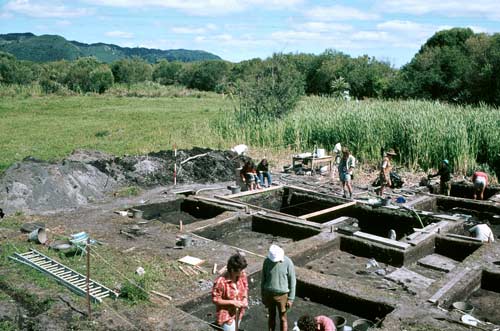
In the 1970s, drainage work on swampy land near Whakatāne, Bay of Plenty, uncovered a well-preserved 17th-century Māori village – Kohika. Archaeologists soon began digging, and over the next 30 years found a wealth of information about the inhabitants and their life. Abandoned after a flood, the village and its artefacts were preserved in the peat that developed over it. The site was on the banks of a lake in the extensive swamplands of the Rangitāiki Plains. Wetlands were favoured by Māori as they contained plentiful food and fibre, and had waterways that linked the coast with the forested interior.
Te whakamahi i tēnei tūemi
Reference: Geoffrey Irwin, ed., Kohika: the archaeology of a late Maori lake village in the Ngati Awa rohe, Bay of Plenty, New Zealand. Auckland: Auckland University Press, 2004
by Geoffrey Irwin
This item has been provided for private study purposes (such as school projects, family and local history research) and any published reproduction (print or electronic) may infringe copyright law. It is the responsibility of the user of any material to obtain clearance from the copyright holder.