

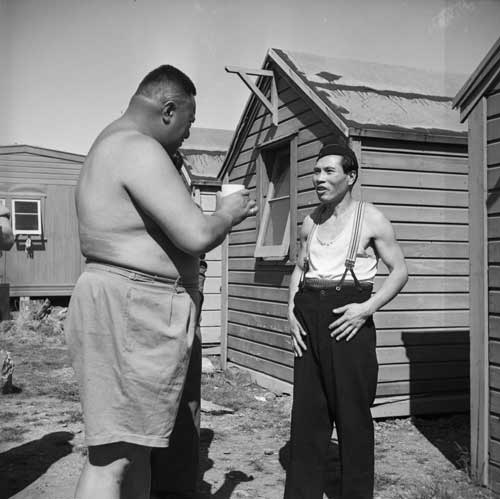
During the Second World War in September 1942, at the request of the US military, an internment camp for Japanese army prisoners of war was established at Featherston, near Wellington. Pictured here are a Māori guard and one of the prisoners. By 1943 the camp held about 800 Japanese, mostly captured in the South Pacific. While many accepted their situation, some refused to work, and in February 1943 they went on strike. This sparked a tragic incident where armed guards opened fire on the prisoners, killing 31 instantly; 17 died later. Below is an account of the event.
Dreams of warriors
The Japanese never did invade New Zealand, despite widespread fears. But in 1942–43 the New Zealand government brought in 868 prisoners of war from Guadalcanal. The first group were mostly civilians who had been drafted into the Japanese navy. Later, captured or injured military personnel were also interned.
They were taken to a prisoner of war camp at Featherston, north of Wellington, where they were set to work weeding, planting and making furniture. Years later in his memoir The path from Guadalcanal (Auckland: Outrigger, 1979, p. 64), naval officer Michiharu Shinya described Lieutenant Colonel Donald Donaldson, the camp commandant: ‘[He] was a lean figure, and a man of few words and chilly manner, a character ever so much the stamp of an English gentleman’.
The earlier arrivals generally accepted their lot, but some military prisoners regarded capture as the ultimate disgrace – the belief that it was deeply shameful to work for the enemy was instilled in childhood. Rather than return home as outcasts, they refused to work. Some wanted to die by suicide and on one occasion pressured officers to ‘give us a lead’. A Japanese lieutenant told them that Japan needed them, but that he respected their position. At this point, the men did nothing.
On 25 February 1943, however, a group of about 240 staged a sit-down strike in their compound, refusing to work. Armed guards were brought in. One lieutenant, Adachi, refused to come out of the compound, and sat with his men. They demanded a meeting with the commandant, who instructed his adjutant to get them back to work.
Accounts vary on what happened next. It is believed that the camp adjutant shot and wounded Adachi. The Japanese then rose, either starting to rush or seeming about to rush at the guards. Although there had been no order to shoot, the guards opened fire with rifles and sub-machine guns as the Japanese threw stones and moved towards them.
The shooting lasted about 30 seconds. Thirty-one Japanese were killed instantly, 17 died later, and about 74 were wounded. One New Zealander was killed and six were wounded.
A military court of enquiry exonerated New Zealand, but acknowledged the fundamental psychological and racial differences between captor and captive, and the lack of a common language. The Japanese government did not accept the court’s decision.
After the war, the first prisoner of war to return to Featherston burned incense at the site in 1974. In a joint project with the Japanese, a memorial ground was established in 1976. Shuriken, a play about the incident by Vincent O’Sullivan, was performed in 1983. In 2002 the artist Robin White exhibited 12 panels depicting what was left of the camp.
The tragedy remains a testimony to cultural misunderstanding. Today, a plaque commemorates the site with a 17th-century haiku:
Behold the summer grass
All that remains
Of the dreams of warriors.
Te whakamahi i tēnei tūemi
Alexander Turnbull Library, John Dobrée Pascoe Collection (PAColl-0783)
Reference: 1/4-000790: F
by John Dobrée Pascoe
Permission of the Alexander Turnbull Library, National Library of New Zealand, Te Puna Mātauranga o Aotearoa, must be obtained before any re-use of this image.
Comments
21 November 2016
31 December 2015
07 May 2014
20 May 2012
02 August 2011
24 August 2010
29 June 2010