Kōrero: Wasps and bees

Certonotus fractinervis female

Image
<em>Certonotus fractinervis</em> female

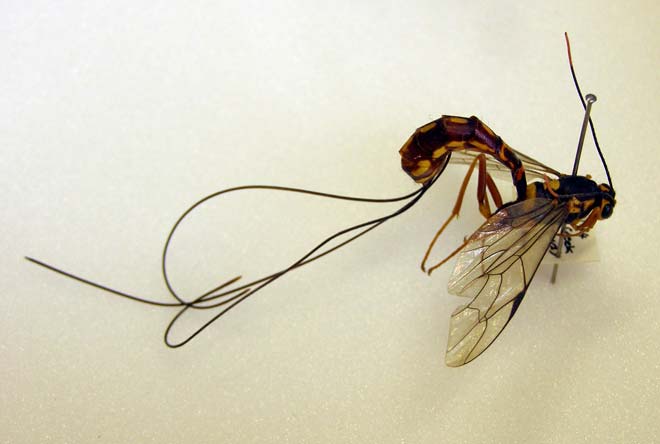
Certonotus fractinervis is the largest native parasitic wasp. It is long and slender, and the female measures up to 40 millimetres. She has an extremely long ovipositor (the three long threads). This bores holes into beech tree trunks to lay eggs in the larvae of elephant weevils, which make tunnels in native trees.

Te whakamahi i tēnei tūemi

Lincoln University, Entomology Research Museum

by Christina Troup

This item has been provided for private study purposes (such as school projects, family and local history research) and any published reproduction (print or electronic) may infringe copyright law. It is the responsibility of the user of any material to obtain clearance from the copyright holder.

Ngā whakaahua me ngā rauemi katoa o tēnei kōrero

Me pēnei te tohu i te whārang

John Early, Wasps and bees – Parasitic wasps, Te Ara – the Encyclopedia of New Zealand, https://teara.govt.nz/mi/photograph/11146/certonotus-fractinervis-female (accessed 4 June 2026).

He kōrero nā John Early, i tāngia i te 1 March 2009.

Comments

Charles
30 December 2011
I have a 300ha plantation at Leslie Hills in North Canterbury and have noticed some of those very large parasitic wasps, Certonotus fractinervis. There are a lot of rotting thinnings so I presume there are weevil larvae in those, as there are no beech trees for miles around? The one I saw first was trying to bore into a hard dry dead tree, without much luck. Do the weevils infest live trees too?