

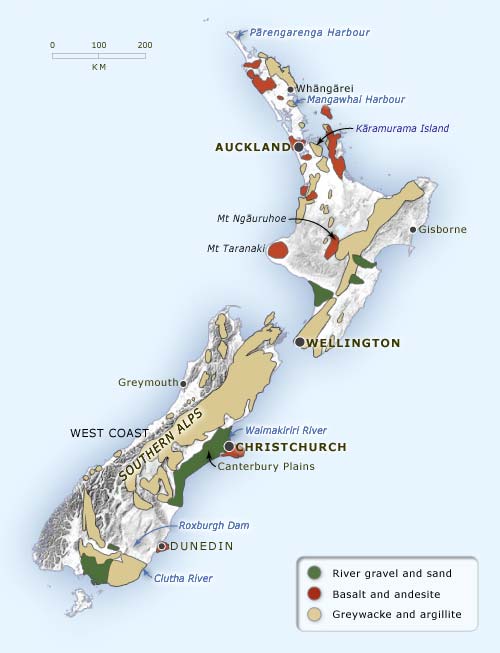
New Zealand is well endowed with high-quality rocks suitable for aggregate. Greywacke and argillite (shown in yellow) are the most widespread, as they form many of the country’s mountain ranges. Rivers eroding these mountains wash down billions of tonnes of sand and gravel onto the plains (in green). Quarries that work these deposits are termed gravel pits as they are simply holes dug into the plains. The word quarry usually refers to places where bedrock is mined, often with explosives. Many New Zealand basalts and andesites, which are volcanic rocks (in red), also make ideal aggregate. These are quarried from hard rock.
Te whakamahi i tēnei tūemi
Te Ara - The Encyclopedia of New Zealand
Source: GNS Science
This item has been provided for private study purposes (such as school projects, family and local history research) and any published reproduction (print or electronic) may infringe copyright law. It is the responsibility of the user of any material to obtain clearance from the copyright holder.