

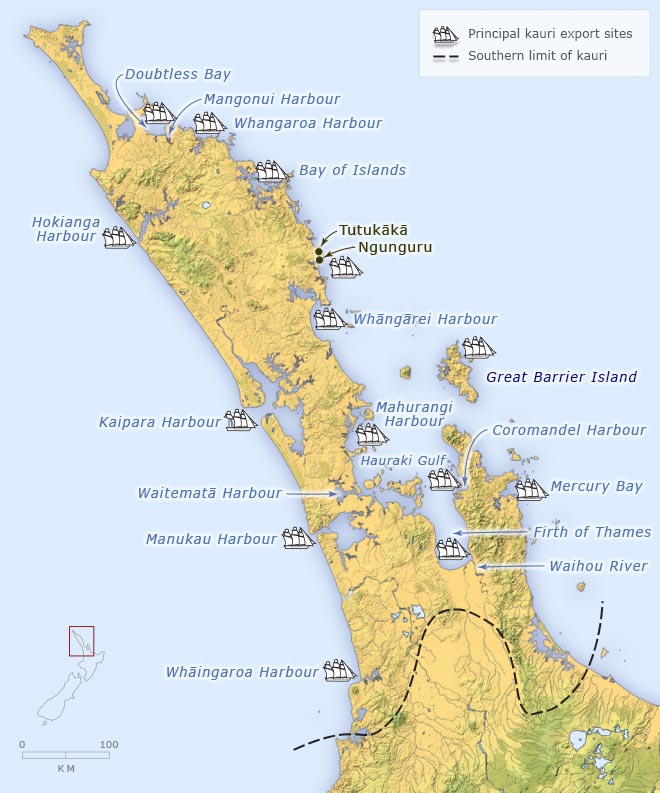
In the 1820s and 1830s, timber stations were set up at harbours around the coasts of Northland, the Coromandel Peninsula and northern Waikato. Māori felled and milled kauri trees at these stations, usually supervised by European sawyers. The timber and spars were shipped to Britain and, from the 1830s, to the new Australian colonies.
Te whakamahi i tēnei tūemi
Te Ara - The Encyclopedia of New Zealand
Source: Roger Philip Wigglesworth, ‘The New Zealand timber and flax trade, 1769–1840.’ PhD thesis, Massey University, 1984
This item has been provided for private study purposes (such as school projects, family and local history research) and any published reproduction (print or electronic) may infringe copyright law. It is the responsibility of the user of any material to obtain clearance from the copyright holder.