

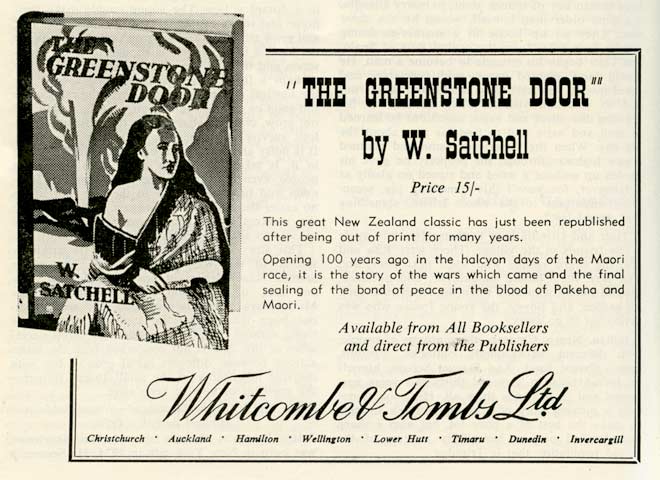
William Satchell's The greenstone door (1914) has been reprinted a number of times, which testifies to its enduring significance. The main character is Cedric Tregarthen, a Pākehā boy who grows up in a Māori community in the mid-19th century. During his time there, he and a Māori boy of similar age, Rangiora, put aside their racially charged enmity. They take an oath of peace in which the symbolic greenstone door of the book's title is closed, representing the end of conflict.
As a teenager Cedric is sent to live in Auckland so he can immerse himself in Pākehā culture. War breaks out, and Cedric is present at the siege of Ōrākau in 1864, where his beloved foster sister Puhi-Huia is killed. Friends on the government side are also killed, and the strain of Cedric's divided loyalties cause him to fall ill. He is nursed back to health by Helenora, with whom he had fallen in love in Auckland. Their relationship enables the closure of the greenstone door for good.
The greenstone door has been recognised for its sensitive treatment of Māori and Pākehā characters and its portrayal of the warm relationships between two peoples. This advertisement appeared in 1957 in Te Ao Hou, the magazine produced by the Māori Affairs Department for a Māori audience.
Te whakamahi i tēnei tūemi
Māori Purposes Fund Board
This item has been provided for private study purposes (such as school projects, family and local history research) and any published reproduction (print or electronic) may infringe copyright law. It is the responsibility of the user of any material to obtain clearance from the copyright holder.