




Rock lobster or crayfish?
Although they are often known as crayfish or crays in New Zealand, marine rock lobsters inhabit rocky reefs at depths of 5 to 275 metres and quite different to freshwater crayfish.
Overseas, they have been marketed as rock lobster, and this name now has official status. To add to the confusion, two species occur around the coast. Red rock lobsters (Jasus edwardsii), also known by their Māori name kōura papatea, are more common, although the larger green packhorse rock lobsters (Sagmariasus verreauxi), or pawharu, are widespread. Red rock lobsters are also known as spiny rock lobsters because of the spiny growths on the sides of their tail. In contrast, packhorse lobsters are sometimes called smooth-tailed rock lobsters.
Two other marine rock lobsters occur in New Zealand waters: the deepwater species Projasus parkeri and the tropical group Panuliris, confined to the reefs around the Kermadec Islands.
Body and senses
Red rock lobsters grow to about 45–50 centimetres long and typically weigh around 2–3 kilograms, although 8-kilogram individuals have been caught. Packhorse rock lobsters grow up to 60 centimetres long and reach weights of 15 kilograms.
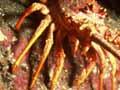
Rock lobsters share well-endowed with features that help them explore and respond to their surroundings. A pair of long antennae project from their heads and can be rotated in all directions to touch and explore their rocky habitat. These also serve as defensive lances, as they have serrated edges and can be used to poke or frighten off predators.
Between the antennae is a pair of short, jointed feelers that function as sniffers, detecting chemicals in the water. They can detect the slightest of movements when under water, but bright sunlight may damage their eyes when they are pulled from the water.
Adult life
For much of their life red rock lobsters are social animals with quite complex behaviour. During the day they hide in caves and crevices, and at night they venture out in search of food. Sea stars, kina (sea urchins), crabs and shellfish make up the bulk of their diet.
Rock lobsters reach maturity around 7–11 years of age. Mating occurs in late summer and autumn. They signal their readiness to mate by releasing urine. A male deposits sperm onto the female’s abdomen as she releases her eggs. She gathers the fertilised eggs and attaches them to long hairs under her tail, where they remain for three to five months before hatching.
Larvae
A newly hatched rock lobster larva makes a one- to two-year journey out into the South Pacific Ocean, where it floats about feeding and undergoing numerous moults before swimming back to the coast. It has a few changes of identity along the way.
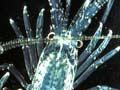
It begins life as a small spidery creature called a naupliosoma larva. After hatching, the naupliosoma swims up toward the surface and undergoes another moult into a leaf-like larva, known as a phyllosoma. In this form, the larva spends an extended period floating in ocean currents that carry it far from shore.
The final phyllosoma moult transforms the larva into a miniature (2.5 centimetres) transparent version of the adult, known as a puerulus or postlarva. It is at this stage that the rock lobster swims back to the coast. It is a mystery how the postlarvae know their way back.
Trans-Tasman crossing
Red rock lobsters are also found around southern Australia. Scientists think that many phyllosoma larvae drifting in the Tasman Sea might have hatched in Australia. If they survive the crossing, these little Aussie reds develop into kiwi rock lobsters.
Migratory juveniles
Sometimes juvenile rock lobsters embark on extraordinary migrations along the east coasts of the North and South islands. Some originally tagged in Otago have been caught in Fiordland – after a journey of 850 kilometres. They walk along the sea floor against the current, down the Southland coast, around the southern tip of Stewart Island then up the Fiordland coast towards South Westland, where their journey ends.
Mass migrations are exceptional. One occurred in 1970 and the next in 1993, but each year a few rock lobsters migrate over large distances. The reason they undertake these trips is unknown, although it has the effect of spreading the population around the coast.