Kōrero: Reserve Bank

Floating the New Zealand dollar

Image
Floating the New Zealand dollar

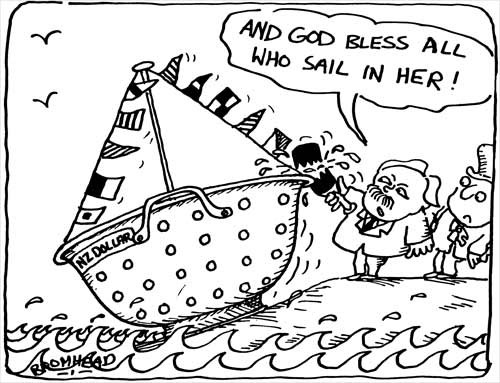
In 1985 the New Zealand dollar was floated. This meant that the market would control the international value of the dollar instead of New Zealand. The idea was that balance-of-payments crises would not occur because the currency would self-correct. In practice, balance-of-payments problems continued to occur. This cartoon, featuring Minister of Finance Roger Douglas, takes a rather negative view of the float – the boat is a kitchen colander and thus full of holes.

Courtesy of Peter Bromhead

Te whakamahi i tēnei tūemi

Alexander Turnbull Library

Reference: A-314-1-019

by Peter Bromhead

Permission of the Alexander Turnbull Library, National Library of New Zealand, Te Puna Mātauranga o Aotearoa, must be obtained before any re-use of this image.

Ngā whakaahua me ngā rauemi katoa o tēnei kōrero

Me pēnei te tohu i te whārang

John Singleton, Reserve Bank – Reserve Bank, 1936 to 1984, Te Ara – the Encyclopedia of New Zealand, https://teara.govt.nz/mi/cartoon/33456/floating-the-new-zealand-dollar (accessed 4 June 2026).

He kōrero nā John Singleton, i tāngia i te 20 March 2012.

Comments

Bijou Smith
15 January 2020
The correct story is that serious balance of payments crises never occurred after the NZD float, but trade imbalances did. That's only natural as export/import markets adjusted to an unstable political climate. Without the float things would have been a HELL of a lot worse. The float was a good thing. Contrary to what most people think, a floating fiat currency gives governments monetary sovereignty, meaning domestic taxation entirely drives the value (for real goods domestically), nothing else. On ForEx markets the fluctuations are natural and only reflect trade conditions, not relative domestic prices (it does affect absolute price levels because it can make imports more expensive if the NZD devalues). So if NZ has unreliable trade and current account balances, then the NZD will fluctuate a lot. That's proper and natural, if NZ Gov tried to fix or peg the exchange rate they'd have to BORROW foreign currency, which is an immediate debt default risk. By contrast, thanks to a floating fiat currency the NZ gov never needs to borrow foreign currency and can always pay debt denominated in NZD without going bankrupt (because it is the sole monopoly issuer of NZD)..