

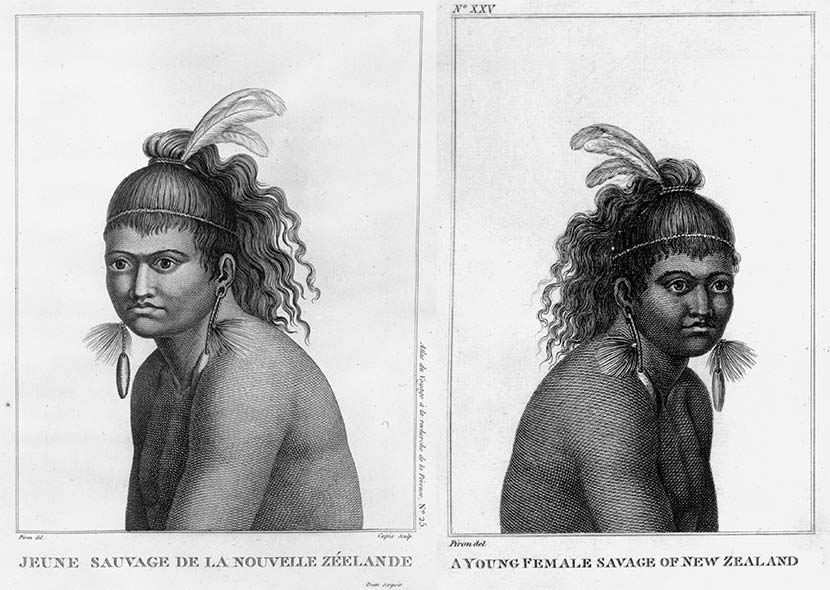
In the late 18th and early 19th centuries Māori people appeared both fascinating and threatening to the first Europeans to see them. Illustrations of Māori were popular in Europe. Reproductions often displayed racial attitudes that the original artists did not intend. This drawing by the French artist Jean Piron (left), shows a young Māori man he saw near Cape Rēinga in 1793. In 1800 a book was published with a version of this image redrawn to show a young Māori woman. A female with feathered earrings would have been more interesting to many readers than Piron's original image.
Te whakamahi i tēnei tūemi
Reference: PUBL-0057-25 (left); PUBL-0056-25 (right)
by Piron
Permission of the Alexander Turnbull Library, National Library of New Zealand, Te Puna Mātauranga o Aotearoa, must be obtained before any re-use of this image.