… the South Island, the West Coast is the longest region in New Zealand (from latitude 40°50’ to 44°15’ south). Its length … here has always been hard. Mining, timber milling, farming, fishing … They’re all hard yakker [work] and they breed hard …
Type: Story Page
… represent the interests of whole industries, such as fishing; whole sectors, like retailing; and trades, such as … owner-driver associations) and a fleet operator group (the New Zealand Road Transport Association). Over the years, these …
Type: Story Page
… clash later that year began one of the great rivalries in New Zealand rugby, between the maroon of Southland and the blue … the New Zealand grand prix half a dozen times. Hunting and fishing The Southland back country provides many …
Type: Story Page
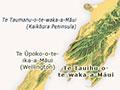
… known as Te Hiku-o-te-ika-a-Māui, the tail of Māui’s fish. European explorers and traders arrived in the 19th … is at the southern end, near Ahipara. Plucky William Puckey New Zealand’s first-known land yacht was sailed along Ninety …
Type: Story Page
… Mission schools The mission stations set up throughout New Zealand from the early 19th century were the major influence … (when the worn out net lies heaped up, the new net goes fishing) refers to the way each generation is succeeded by …
Type: Story Page
Part of story: Ngā tamariki … to the beginnings of human existence. It was he who fished up the North Island from the ocean depths. This … The epic character Paikea is a key ancestor who came to New Zealand on the back of a whale. His story is shadowed by …
Type: Story Page
Part of story: Ngāti Porou … New Zealand snipes The endemic New Zealand snipes ( Coenocorypha species) are among the … a back-up population. Thirty birds were released on Codfish Island in 2012. Snipe on Jacquemart Island As rats had …
Type: Story Page
Part of story: Wading birds … Te Aupōuri and Te Rarawa. Te Hiku-o-te-Ika: the tail of the fish The Muriwhenua people occupy the lands between the … Rēinga, this cape is one of the most sacred Māori places in New Zealand. Tradition says that the spirits of the dead travel …
Type: Story Page
… consists of crystalline rocks, including granite. Some of New Zealand’s oldest rocks are found there. Hard and resistant, … settlement was made in the 1890s – neither gold mining nor fishing thrived. Lost and found People have speculated that …
Type: Story Page
… at, or very close to, the water’s surface. Two of the eight New Zealand breeding species, the fairy prion ( Pachyptila … open wings. They generally feed on small crustaceans and fish. Breeding Diving petrels breed on small islands …
Type: Story Page
… Hawaiki. In 1900, a correspondent for the Māori-language newspaper Te Pipiwharauroa described this dolphin playfully … Pass. He described it as an ‘ika tipua’ (supernatural fish) and suggested it could be a taniwha. In the Far North … as a guardian of the Māhuhu canoe on its voyage to New Zealand. Later he acted as a guardian for his people, Ngāti …
Type: Story Page
… Legendary Polynesian navigator Kupe’s early exploration of New Zealand is commemorated in many ancient place names. Kupe … lived together in the centre of the North Island, the fish which Māui hauled from the sea. One day Taranaki …
Type: Story Page
… penguin and the yellow-eyed penguin both breed on the New Zealand mainland. Little penguins The little penguin or … Strait and the nearby islands, including Stewart and Codfish islands. No visitors allowed Codfish Island, to the …
Type: Story Page
… region was one of the most densely forested areas of New Zealand. Over several hundred years Māori partially cleared … set lines are prohibited, recreational and some commercial fishing is permitted. The islands are home to one of the …
Type: Story Page
Part of story: Taranaki region … How gum forms New Zealand’s giant kauri trees ( Agathis australis ) ooze resin … start fires or bound in flax to make a torch for night-time fishing. Gum was also used for moko (facial tattoos): the …
Type: Story Page
… Sporting heroes Three South Canterbury names belong to New Zealand’s sporting history. One of the world’s most … it had gained a reputation for having some of the best fly-fishing in New Zealand. In recent decades, pollution and the …
Type: Story Page
… of life. The moon was also used as a guide for planting and fishing. The stars Several hundred Māori star names survive from the time before Europeans arrived in New Zealand. Unfortunately, apart from the more prominent stars …
Type: Story Page
… controversies of the 1970s, many experts felt that New Zealand’s protected area system was skewed towards mountains … been widespread opposition from commercial and recreational fishers. Marine reserve law currently has a rather narrow …
Type: Story Page
Part of story: Protected areas … Aquaculture in New Zealand Green-lipped mussels, quinnat salmon and Pacific … New Zealand aquaculture is not restricted to the farming of fish, but also includes the rearing and cultivation of …
Type: Story Page
Part of story: Aquaculture … of home-made cakes and biscuits is a distinctive feature of New Zealand cookery. Scottish migrants brought their love of … way to cook smaller cuts of meat and sausages, bacon and fish. Boiling and steaming New Zealand vegetable cookery …
Type: Story Page