… Gargiulo, immigrants from Resino, Italy. Francesco, a fisherman, had worked at Eastbourne from 1914 until 1920, … he returned to Italy to marry. In 1921 he arrived back in New Zealand with Gelsomina and settled in Island Bay, a focal …
Type: Biography
… St Louis Exposition, 1904 From the turn of the century New Zealand’s displays at international exhibitions were fewer … States, where Donne arranged for a place in the Forestry, Fish and Game Building as well as the Palace of Agriculture. …
Type: Story Page
… or metaphorical way. The North Island was Te Ika-a-Māui, a fish caught by the demigod Māui; the country was Aotearoa, … for its aesthetic qualities) was a cultural import to New Zealand from Europe. Even there, the practice of climbing a …
Type: Story Page
… hard-working and enterprising people continued to settle in New Zealand, which, as a 19th-century promoter of immigration … to 5,352. Work Italians no longer work in agriculture or fishing as they did before the First World War. Changes made …
Type: Story Page
… whaling stations, dams and mills. Conservation Since the New Zealand Forest Service began regenerating the kauri forest … are 500 plant species on the island, 70 different types of fish, and a pristine mangrove forest. Population The …
Type: Story Page
Part of story: Auckland places … 176 and 177° west longitude, whereas the main islands of New Zealand straddle 175° east longitude. This would ordinarily … The islanders have long made a living from sea and land. Fishing and crayfishing play an important part in the …
Type: Story Page
Part of story: Chatham Islands … and natural childbirth helped shape modern midwifery in New Zealand. She argued that women should have the right to … tuberculosis, logging injuries and childbirth. Joan married fisherman Robert (Bob) Fuhland Donley (1914–1992) in …
Type: Biography
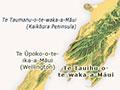
… mythology describes how the demigod Māui hooked a huge fish and hauled it out of the sea. His catch, Te-Ika-a-Māui … is derived from Whātaitai). Geology Wellington is the only New Zealand city to be built on a bed of greywacke (a hard grey …
Type: Story Page
… Who were the sealers? Most of the sealing in New Zealand was organised by Sydney companies, nearly all … often scarce, and they lived off dry cakes, seal meat or fish, often suffering from scurvy because of the lack of …
Type: Story Page
… a rocky shoreline, attracts surfcasters, divers and people fishing from boats. There are many historic pā sites, and … to be the oldest (more than 600 years) and largest in New Zealand, stands in the grounds of Te Kura-a-Rohe o Te Waha o …
Type: Story Page
… A dynamic landscape When James Cook first arrived in New Zealand, in 1769, the ship’s naturalist, Joseph Banks, … had their own traditions. After the legendary hero Māui fished up the North Island with his magic hook, the …
Type: Story Page
… of Hīma when she lost a club) or Hī matangi (Matangi fishes, referring to the chief Matangi who lured a taniwha … to places. Waters Māori also named all the waters around New Zealand. The Pacific Ocean was Te Moana-nui-a-Kiwa (the …
Type: Story Page
… leaves the main line. A 1972–74 plan for a substantial ‘new town’ was abandoned, but Rolleston has since grown fast. … area), and the fifth largest enclosed body of water in New Zealand. It is about half the size it was when Europeans … people. Huts Canterbury people use the word ‘huts’ for a fishing and holiday settlement at a lake or river mouth. …
Type: Story Page
… Nearly 500 species have been described from around New Zealand, and most are distinct to the southern hemisphere. … other soft-bodied creatures. Like insects, crabs, and crayfish, penis worms moult. Horseshoe worms Only three species …
Type: Story Page
… become unavailable for treaty settlements. In 1987 the New Zealand Māori Council took a case to the Court of Appeal … for the first time. Landmark claims and reports Muriwhenua Fishing (1988): The claim by the iwi of the Muriwhenua …
Type: Story Page
… Americans (people from Central and South America) came to New Zealand. Yet stereotypes were evident from early on. One … just please ourselves – from pastel de choclo one day, to fish and chips the next ... So with the language and with …
Type: Story Page
Part of story: Latin Americans … the town was named after Thomas Gore Browne, governor of New Zealand between 1855 and 1861. However, Gore did not become … The river is internationally known for its brown trout fly-fishing. The main lower tributary is the Mimihau, which …
Type: Story Page
… to action. One project aims to increase the population of New Zealand’s famous flightless bird, the kiwi. Tactics include … to Cape Brett at the entrance to the Bay of Islands. Shore-fishing excursions are run from Whangārei (December to …
Type: Story Page
… canning, and 300 hectares was in orchards. In the 1950s the fishing industry expanded with the arrival of individuals … reached 20,000, and it was designated a city. It was one of New Zealand’s most prosperous cities through the 1960s, and in …
Type: Story Page
… Timaru. He then joined the war effort as a member of No 1 New Zealand Stationary Hospital; he was to rise to the rank of … referee. He also enjoyed more solitary pursuits such as fishing and shooting. In 1940 he took up painting after …
Type: Biography