… had its origins in huts and lodges built for visitors fishing the Tongariro River, and it still calls itself the ‘trout fishing capital of the world’. New town From the mid-1960s, the fishing settlement was … Judges, Sportsman’s, Bridge and Lonely. Tongariro River New Zealand’s premier trout-fishing river, its waters rise on …
Type: Story Page
… Most native freshwater fish species are called galaxiids (from the family name … in the family and two ( Galaxias and Neochanna ) occur in New Zealand. The name refers to their profusion of small, …
Type: Story Page
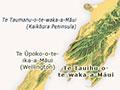
Part of story: Freshwater fish … The North and South islands of New Zealand are known respectively as the fish and canoe of the legendary hero Māui. Māui fishes up …
Type: Story Page
… trout ( Salmo trutta ) form the basis of most freshwater fishing in New Zealand. A successful import From the late 1860s brown …
Type: Story Page
… Fisherman Stewart Smith transformed the ecology of New …
Type: Biography
… are often encrusted with barnacles. One way humpbacks catch fish Humpbacks have developed a technique known as bubble … and over. Migration Humpbacks are occasionally seen off the New Zealand coast, swimming between the Antarctic, where they …
Type: Story Page
… of black-footed shag ( Phalacrocorax genus) living in New Zealand, the best known and most widespread is the black … such as China and Japan, it has been trained to capture fish for humans; a ring around the neck prevents the bird …
Type: Story Page
… it serves locals, and those involved in yachting, big-game fishing and diving. Kaeo Township on the Kaeo River, which … found in the river. Kaeo was the site of Wesley-Dale, New Zealand’s first Wesleyan Mission station, established by …
Type: Story Page
… the links between the ancestral homeland of Hawaiki and New Zealand, the cradle of Māori culture. Māui, a god-like … ancestor, travelled by waka into the southern ocean and fished up the North Island, known as Te Ika-ā-Māui (the fish …
Type: Story Page
Part of story: Waka – canoes … hunting. Of the world’s 36 shag species, 12 are found in New Zealand. Eight of these are endemic – they are found nowhere … deeper water. Others are found inland, where they dive for fish and other prey in lakes and rivers. Several that live …
Type: Story Page
… Joseph August Perano was born at Dunedin, New Zealand, on 10 October 1876, the third of eleven children of … and his wife, Susan Williams. Agostino was a Picton-based fisherman of Italian extraction, and Joe followed his father …
Type: Biography
… Waka ama is the New Zealand term for the sport of outrigger canoeing. The name … (war canoes), waka tīwai (river canoes) and waka tētē (sea-fishing canoes), have a single hull, carved from a tree …
Type: Story Page
… some freezing works also had shop outlets. In 1896 the New Zealand Refrigeration Company bought its first shop in … to cater for a specific market – such as a wealthy suburb. Fishmongers In the 1800s, as towns grew, small-scale … Butchers and fishmongers …
Type: Story Page
Part of story: Food shops … order Cetacea, which includes all whales and dolphins. In New Zealand there are 10 species and one subspecies of dolphin, … the accidental catching of Hector’s and Māui’s dolphins in fishing nets. Common dolphin The short-beaked common dolphin …
Type: Story Page
… Giuseppina Costelano. Activities centred around the sea and fishing, growing grapes and wine-making, and tending … a passage home, but he continued at sea and arrived in New Zealand in 1881, aged 14 years. A brother, Gaetano, followed …
Type: Biography
… Discovery and migration New Zealand has a shorter human history than almost any other … gathering remained the main mode of survival. Gardening and fishing The Polynesians brought with them kūmara (sweet …
Type: Story Page
… Māori fishing In spring, Māori caught whitebait moving upstream, … also sold their catch. In her book Station life in New Zealand (1870), Lady Mary Anne Barker described how she ‘had …
Type: Story Page
… Surviving in a new land When the Polynesian ancestors of Māori arrived in New Zealand after a long time at sea, they would have been … of middens show that bird and seal bones were replaced by fish bones and shells. Eat or be eaten The first Polynesian …
Type: Story Page
… small country far from the centres of Western civilisation, New Zealanders have always been highly sensitive about the views … the valleys appeared rich and fertile. The seas had many fish that made good eating. There were no wild beasts, …
Type: Story Page
… or three years, and then return to their hatching site in New Zealand in early spring. The two-way journey is fraught with … 1 and 20 metres above the sea, looking for schools of fish or squid. They plunge headlong as soon as they spot …
Type: Story Page