Story: Parliament

Changing to MMP

Image
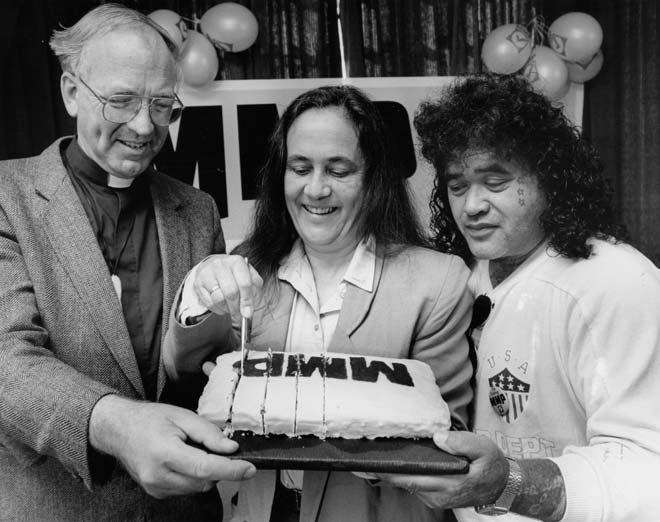
Three people around MMP cake with lit candle

The campaign to change the country’s voting system from first-past-the-post to MMP (mixed member proportional representation) was mounted by people who wanted a Parliament which was more responsive to different interest groups. The aim was also to curb the domination of the House by a majority party. These supporters of the movement, shown cutting an MMP cake, are (from left) Anglican clergyman Richard Randerson, author Patricia Grace and Black Power president Rei Harris. In a 1993 referendum, New Zealand voters supported the change.

Using this item

Alexander Turnbull Library, Dominion Post Collection (PA-Group-00685)

Reference: EP/1993/3398/14-F

by Phil Reid

Permission of the Alexander Turnbull Library, National Library of New Zealand, Te Puna Mātauranga o Aotearoa, must be obtained before any re-use of this image.

All images & media in this story

How to cite this page

John E. Martin, Parliament – Impact of MMP, Te Ara – the Encyclopedia of New Zealand, https://teara.govt.nz/en/photograph/2493/changing-to-mmp (accessed 4 June 2026).

Story by John E. Martin, published 3 March 2009, updated 1 February 2015.

Comments

Grant Neville Platt
10 April 2023
Hello. I was Convenor of the Palmerston and Manawatu branch of the Electoral Reform Coalition in the early 1990s. I was associated with many people in groups like The Women's Electoral Lobby. We all had the aim of having an Electoral System which gave fair representation. First-Past-The-Post Voting doesn't do that. I wanted a fair system which ensured fair representation for all groups according to their level of voter support. Both MMP and STV (Single Transferable Voting) would have done that. But the government of the day had a biased system in favour of FPP. The most supported reform option (MMP) had to run off twice, in 1992 and then in the Binding Electoral Referendum of 1993 to lead to change. It would have been good to decide on reform in the 1992 Indicative Referendum then have the two most favoured reform options, MMP and STV run off against each other. Yet despite the negative advertising campaign by the pro-MMP Campaign For Better Government in 1993, with hooded figures, crying babies and dinosaurs MMP won the Binding Referendum. It had earlier, in 1986, been supported by the findings of The Royal Commision on The Electoral System in its report Towards A Better Democracy. The ERC had an educative campaign which lead to success in the end but it was a close thing up against the well-financed opposition. The people saw through the emotive advertising.