Story: Wellington region

Belmont Peneplain

Image
Belmont Peneplain

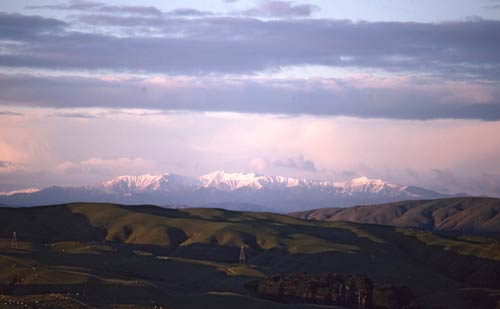
These flat-topped hills (foreground) in Belmont Regional Park are known to geologists as a peneplain or ‘K Surface’ – after Mt Kaukau, a city landmark. They are a feature of the landscape on the western side of the Wellington Fault. In the distance is the sharper outline of the Tararua Range. While the peneplain and the Tararua Range are made of the same greywacke rock, the ranges have been uplifted more rapidly than the hills.

Using this item

Private collection

by Chris Maclean

This item has been provided for private study purposes (such as school projects, family and local history research) and any published reproduction (print or electronic) may infringe copyright law. It is the responsibility of the user of any material to obtain clearance from the copyright holder.

All images & media in this story

How to cite this page

Chris Maclean, Wellington region – Creation stories and landscape, Te Ara – the Encyclopedia of New Zealand, https://teara.govt.nz/en/photograph/13177/belmont-peneplain (accessed 4 June 2026).

Story by Chris Maclean, published 3 March 2009, updated 1 August 2015.

Comments

Simon Nathan
23 August 2010
It is almost 100 years since Charles Cotton wrote his first paper on the landforms of the Wellington region, identifying the feature that is now known as the K-surface. I’m sure that he would be intrigued to know that people are still discussing some of his earliest work. Cotton (1911, p 249) identified a high-level surface around Mt Kaukau, formed during what he called the Kaukau cycle of erosion. Over the years this surface became known as the Kaukau surface, and this term was used in discussion as well as in publications by Cotton’s students Maxwell Gage and Graeme Stevens. In a paper published after his retirement, Cotton (1957, pp 774-775) suggested that the surface should be called the K-surface to replace what he thought was the “uneuphonious” name Kaukau. Although Kaukau surface continued to be used for many years, it has gradually been superseded by K-surface. But there is little doubt that the surface was named after Kaukau.
Martin Brook
18 August 2010
Hi, the K-surface was named by Cotton with the K short for Key Surface, i.e. the most important surface in the area. It was not named after Kaukau, although Kaukau is part of the surface. See Grapes RH (2008), Geological Society of London Special Publication 301, page 305.