

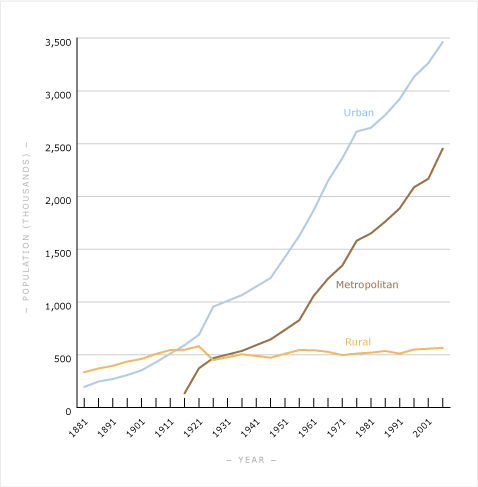
Most New Zealanders have lived in urban areas since the 1910s. Urbanisation has been a consistently upward trend since the 19th century, whereas the numbers living in rural areas have remained relatively static and therefore fallen as a proportion of the total population. The metropolitan population (people in urban areas with a population exceeding 100,000) has increased in tandem with the wider urban population. The figures in this graph before 1926 include estimates of the Māori population, which wasn’t included in official statistics until the 1926 census.
Using this item
Te Ara – The Encyclopedia of New Zealand
Source: T. Papps, ‘Growth and distribution of population.’ In Population of New Zealand / Economic and Social Commission for Asia and the Pacific 12, 2 vols. New York: United Nations, 1985, vol. 1, tables 12 & 19; Ian Pool, Te[no-lexicon] iwi [/no-lexicon]Maori: a New Zealand population, past, present & projected. Auckland: Auckland University Press, 1991; Statistics New Zealand
This item has been provided for private study purposes (such as school projects, family and local history research) and any published reproduction (print or electronic) may infringe copyright law. It is the responsibility of the user of any material to obtain clearance from the copyright holder.