Story: South Canterbury region

The endangered kakī

Image
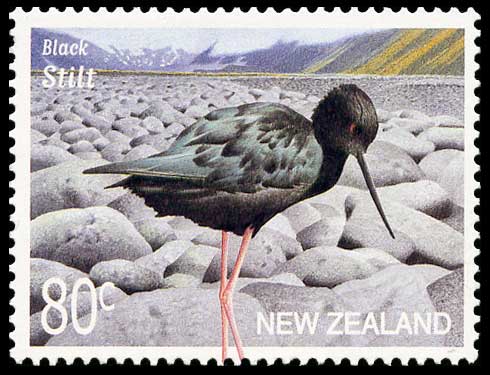
The endangered kāki

The black stilt or kakī is one of the world’s most endangered birds. Once common throughout New Zealand, it is now restricted to the braided rivers of the Mackenzie Basin. Introduced predators and reduction of habitat have been the main reasons for their decline. A captive breeding programme run by the Department of Conservation at Twizel aims to save the kakī from extinction. In 2020 there were 169 adult black stilts.

Using this item

New Zealand Post

Reference: 2000 Threatened Birds stamp series

This item has been provided for private study purposes (such as school projects, family and local history research) and any published reproduction (print or electronic) may infringe copyright law. It is the responsibility of the user of any material to obtain clearance from the copyright holder.

All images & media in this story

How to cite this page

John Wilson, South Canterbury region – Climate, vegetation and wildlife, Te Ara – the Encyclopedia of New Zealand, https://teara.govt.nz/en/photograph/11320/the-endangered-kaki (accessed 4 June 2026).

Story by John Wilson, published 2 March 2009, updated 1 February 2017.

Comments

Richard Thomson
09 March 2013
Kia ora Like many others, I use Te Ara as an authority when deciding whether Māori words need macrons. For example, the Māori Language Commission has guidelines on best practice for spelling and writing Māori (http://www.tetaurawhiri.govt.nz/english/pub_e/downloads/Guidelines_for_Maori_Language_Orthography.pdf) where it says: "For guidance with the use of macrons in names, searching individual names in the Dictionary of New Zealand Biography (www.dnzb.govt.nz/dnzb/) (selecting ‘View site in te reo Māori’) and Te Ara (www.teara.govt.nz) websites will prove useful." With kaki, though, you have kāki on this page and elsewhere (http://www.teara.govt.nz/en/wading-birds/page-3) kaki. I wonder if you can tell me which is right? Many thanks