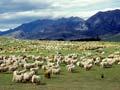
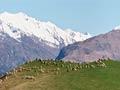
… in the 1980s had a big impact on the Chathams. The New Zealand government became more sceptical about subsidising … a sustainable rock lobster yield continued to be made. Farming Returns from sheep farming fell after 2000 and remained vulnerable to …
Type: Story Page
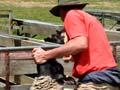
Part of story: Chatham Islands … Taihape Town 84 km north of Bulls and 29 km south-east of Waiōuru, sited above the Hautapu … was 546, larger than it would be a century later. Pastoral farming has always been important in the district, and the town has sculptures of sheep and a huntaway dog. The post office and maternity …
Type: Story Page
… George Rhodes is said to have been born on 14 July 1816, and was baptised on 16 September 1816 at Epworth, … 1851 George and Robert, helped by several men, drove 5,000 sheep from Banks Peninsula to the uninhabited Timaru area. … claimed over 150,000 acres of land and George established a sheep station, which was named the Levels after the …
Type: Biography
… 1849. His father was Wiremu Karaka Te Ito, of Reporua, and his mother was Hera Te Ihi, known also as Ruataupare. He … and a hotel at Waipiro Bay, and supervised the Waiomatatini sheep station, established by Rāpata. Ngāti Porou had learned sheep farming while working for European farmers, and used their …
Type: Biography
… Breed societies and industry organisations help members share information, … and industry organisation The diversification of farming after the economic reforms of the 1980s led to … voluntary members. Breed societies Early on, every breed of sheep, cattle and horse had its own breed society. Since the …
Type: Story Page
… Alexander Robert Fyffe, known as Robert, was the son of James … Weld , and his business extended as far south as Akaroa. Farming, however, became Fyffe's mainstay. By 1849 he was grazing near Kaikōura a flock of sheep belonging to Wellington businessman Robert Waitt, who …
Type: Biography
… Natural erosion The landscape of New Zealand has been shaped by wind, water, … felled the trees for timber. They also cleared the land for farming, by logging trees and setting fire to the … environments. Adding to the impact was overgrazing by sheep and cattle on tussock land in the South Island, and …
Type: Story Page
… inhabitants in 2013. Situated near the Arowhenua forest and close to early crossings of the Ōpihi and Temuka rivers, … came from County Kerry, south-western Ireland. The Levels Farming district 9 km south-east of Pleasant Point. The name … Yorkshire, was given by the Rhodes brothers to the first sheep run taken up in South Canterbury. The family’s …
Type: Story Page
… Inputs New Zealand’s primary industries buy most of their inputs from each … other, because the various forms of pastoral and livestock farming, and some types of horticulture, are interrelated. … capital in the form of land and equipment. Domestic deer Sheep and cattle were the first animals to be commercially …
Type: Story Page
… Useful animals On arrival in New Zealand, both Māori and Europeans needed domestic and wild … missionaries, and later settlers, brought with them cattle, sheep and pigs as a source of food and fibre, and horses and … cats to control rodent pests and dogs to assist with sheep farming. Both Māori and Europeans hunted native birds and …
Type: Story Page
… attempts to establish a formal system for training farmers and young people entering the industry. In the early 1940s … Technical Correspondence Institute offered a course in farming, and by the early 1970s the Trades Certification … 3 trainees can specialise in arable, cattle, dairy, deer or sheep farming. This takes up to 18 months, and covers farm …
Type: Story Page
… settlement in the Nelson region after Nelson city and Richmond. A further 5,397 people live in the surrounding … in 1842. Motueka is primarily a rural service centre. Sheep and cattle are farmed, and hops, fruit (especially … Lower Motueka River valley The lower valley has many small farming localities such as Pangatōtara, Ngatimoti, Pokororo, …
Type: Story Page
Part of story: Nelson places … estates In the 1890s the government wanted to free up more land for settlers and small farmers. Between 1892 and 1912, the Crown bought … – for example, helping each other in turn as they mustered sheep before shearing. From the 1900s, the settled …
Type: Story Page
Part of story: Rural workers … travellers saw plantations of corn, melons, pumpkins and kūmara (sweet potato) in the Tongariro River delta, as … 1830s. In the 1850s Thomas Grace, another missionary, drove sheep from Hawke’s Bay to Pūkawa on the west side of Lake … – easily fixed with fertiliser – triggered the illness. Farming Māori land One of the first land blocks in Native …
Type: Story Page
… in the early 20th century as bush was cleared, land drained, and pasture improved with superphosphate … Although dairying required more labour and capital than sheep and beef farming, it provided regular income, and home-bred animals …
Type: Story Page
… Mary Edith Clarke was born in Waimate North in the Bay of Islands on 23 September 1888, the daughter of Marsden Clarke, a … after their marriage the Scotts moved to a backblocks sheep farm, Strathallan, on the slopes of Pirongia Mountain … into a small dairy herd, but this was not the answer to farming at Strathallan, and in 1927 they moved with their …
Type: Biography
… Hamilton was born on 15 July 1835, in Antwerp, Belgium, and lived there as a child. The son of Mary Wilkinson and … several large clearings in the forest would be excellent sheep country. With the approval of the Maori concerned, he … For nearly 30 years Mangatoro was the district's largest sheep run, and its social and economic centre before the …
Type: Biography
… John Howell was baptised at Eastbourne, Sussex, England, probably on 8 July 1810, the son of William Howell and … New Zealand, Tahiti and California. In 1853 he landed 500 sheep, the first in Southland; cattle were also imported. … schemes and having sold Wreys Bush with its 7,000 sheep and 300 cattle, Howell retired from political life and …
Type: Biography
… Andrew William Rutherford was the eldest of the seven sons … North Canterbury, New Zealand, with staff and stock for a sheep run; the following year the rest of his family joined … Amuri district. He also became a leading breeder of merino sheep from South Australia. He was prepared to spend freely …
Type: Biography
… Tasks such as pumping water for stock, irrigation, drainage and spraying, became increasingly dependent on electricity. … is wasted. As mains supply increasingly reached into sheep-farming areas, electricity was used to power shearing …
Type: Story Page