… By 1891 there were 15 canning factories operating in New Zealand, supplying local and export markets. The sector was … companies. Irvine and Stevenson sold canned fruit, jam, fish and meat from 1864, which was processed in Dunedin …
Type: Story Page
… second sight; and Kui, who introduced the gourd and taro to New Zealand. Māhuhu-ki-te-rangi Māhuhu-ki-te-rangi is the main … and to this day his descendants will not eat that type of fish. Some accounts say that the Māhuhu people returned to …
Type: Story Page
Part of story: Ngāti Whātua … Wharekura. Perhaps the most well-known whare wānanga in New Zealand was Te Rāwheoro at Ūawa (Tolaga Bay). The operation … whare pora (weaving), whare mata (bird-snaring and fishing) and whare tātai (astronomy). Participants were …
Type: Story Page
… it spread along the main tramlines. Outlying villages like New Brighton, Sumner, Papanui and Upper Riccarton were … was sometimes described as the most English of New Zealand’s cities. Tourism ventures exploited this, focusing … rivers for outdoor pursuits such as skiing, snowboarding, fishing, tramping and mountaineering. Until the 2011 …
Type: Story Page
… Animal liberation In the 1970s a new movement – animal liberation – emerged in the wake of … and animal advocacy groups were revitalised. New Zealand organisations In New Zealand small animal rights … Many vegetarians in New Zealand avoid consumption of meat, fish and bird flesh for ethical and political reasons. The …
Type: Story Page
… guidance as to the proper times for planting, harvesting, fishing, hunting and other food-gathering activities. When … in pits; labours are over). 1 An early European visitor to New Zealand, J. S. Polack, noted that ‘the harvest feast was …
Type: Story Page
… layers. This material was plaited by Māori into ropes for fishing nets. Māori experimented with making paper cloth … grows naturally in lowland and coastal forests throughout New Zealand (although it is never common). It is the largest of …
Type: Story Page
… on the road. The swamp harrier also occurs in Australia, New Guinea and many islands of the southern Pacific. In New Zealand harriers are found from the Kermadec Islands in the … up to the size of rabbits, as well as lizards, frogs, fish and large insects. They also eat carrion, including …
Type: Story Page
Part of story: Birds of prey … de Bathe Brandon was born on 21 July 1883 in Wellington, New Zealand, the son of Alfred de Bathe Brandon, a solicitor, … to pursue his leisure interests of horse-racing, golf and fishing. However, the death of his son in a road accident in …
Type: Biography
… Castle Point rock. It is popular for holidays and fishing, and has a safe swimming beach and tidal lagoon. The … lighthouse was built on Castlepoint reef. It is New Zealand’s third highest lighthouse, and sends three flashes …
Type: Story Page
… to arrive from Hawaiki. According to one legend he swam to New Zealand and came ashore at Paerātā, east of the Waiōtahe River. There he released two pet fish in a spring which became known as Ōpōtiki-mai-tawhiti …
Type: Story Page
Part of story: Te Whakatōhea … is Nukutaimemeha – the vessel that the demigod Māui used to fish up the North Island. Oral tradition holds that … carried a number of tohunga. After its arrival in Aotearoa (New Zealand) it made many trips, including along the East Coast. …
Type: Story Page
… of their power – for instance, to bring calm weather for a fishing trip. Tolaga Bay On his first voyage to New Zealand in 1769, James Cook arrived at a spot on the east …
Type: Story Page
… After the depression that lasted into the 1890s, the New Zealand economy recovered. Trade at the regional ports … in New Zealand’s shipping services. Carping at the big fish American writer Mark Twain criticised the powerful …
Type: Story Page
… Sounds. At 163 sq km, it is just over half the size of New Zealand’s largest offshore island, Great Barrier (Aotea). … settlement to the island to hike, cycle, kayak, dive and fish. Stephens Island (Takapourewa) Island off Cape …
Type: Story Page
… Lake Taupō At 623 sq km, Lake Taupō is New Zealand’s largest volcano and its largest lake. It occupies … Ngāti Tūwharetoa, and a new regime was set up to manage the fisheries of the lake and its tributaries. Western Bay The …
Type: Story Page
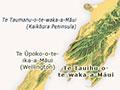
… Remote in the Southern Seas New Zealand lies about 1,600 km from both Australia and … long, narrow shape – the North Island is Te Ika a Māui (the fish of Māui , a legendary character), and the South is Te …
Type: Story Page
… Aorere river valleys. Second English settlement Nelson was New Zealand’s second planned European settlement (Wellington was … industries in the early 20th century – as did tourism, fishing and aquaculture in the late 20th century. Since the …
Type: Story Page
Part of story: Nelson region … the time of Duncan’s birth Archibald was serving with the New Zealand Expeditionary Force at Gallipoli; he later fought on … foresaw economic opportunities for Māori in forestry and fisheries, emphasised ‘self-help’ and urged iwi and hapū to …
Type: Biography
… Mai-i-raro (migration from below: in the legend of Māui, New Zealand’s northern region forms the tail, or lower part of the ‘fish’). Te Whatanui was the chief of this group. These …
Type: Story Page
Part of story: Ngāti Raukawa