

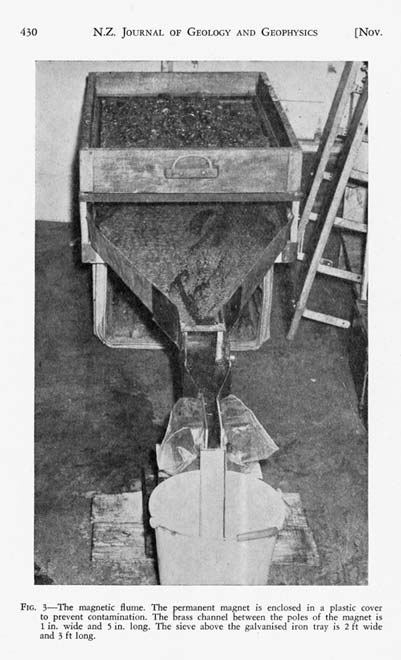
In the early 1960s marine geologist Henry Pantin made magnetic concrete out of black sand, which contains the mineral titanomagnetite. He crushed the concrete into pebbles, and placed it in piles on the floor of Cook Strait. Three days later he collected samples from the surrounding area to see how far the crushed concrete had moved. This device sorted the magnetic from the ordinary sediment. By measuring the distance it had travelled, he calculated that currents in Cook Strait sped along at 40–50 centimetres per second.
Using this item
Reference: NZ Journal of Geology and Geophysics 4, no. 4 (November 1961): 430
Permission of the Alexander Turnbull Library, National Library of New Zealand, Te Puna Mātauranga o Aotearoa, must be obtained before any re-use of this image.