

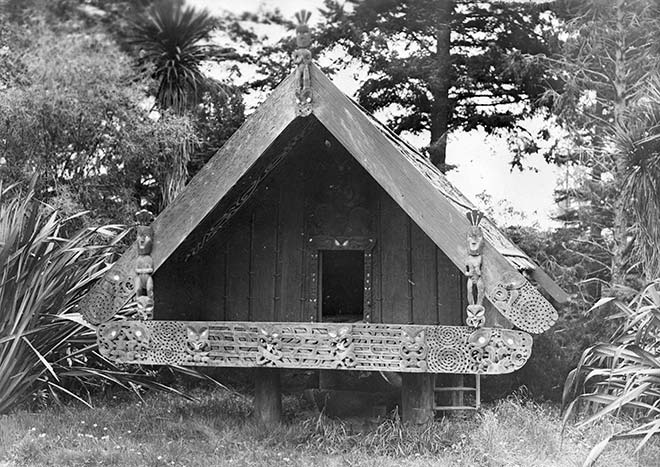
Māori sometimes used art to make political statements. In the 1850s Te Āti Awa chief Wī Tako Ngātata commissioned the building of the pātaka (storehouse) Nuku Tewhatewha. Built in 1856 in Naenae, it was one of seven pātaka or 'Pillars of the Kingdom' that were built across the North Island as a symbol of the fledgling Kīngitanga (Māori King movement), and is the only one to survive. Its carvers included Horonuku Te Heuheu of Ngāti Tūwharetoa. In 1861 the pātaka came under the stewardship of the Beetham family. In 1889 they moved it to their Thorndon home and then to their Wairarapa pastoral estate, Brancepeth, where this photograph was taken. In 1982 Nuku Tewhatewha returned to Lower Hutt and was placed in the Dowse Art Museum.
Using this item
Reference: 1/1-000641-F
Permission of the Alexander Turnbull Library, National Library of New Zealand, Te Puna Mātauranga o Aotearoa, must be obtained before any re-use of this image.