

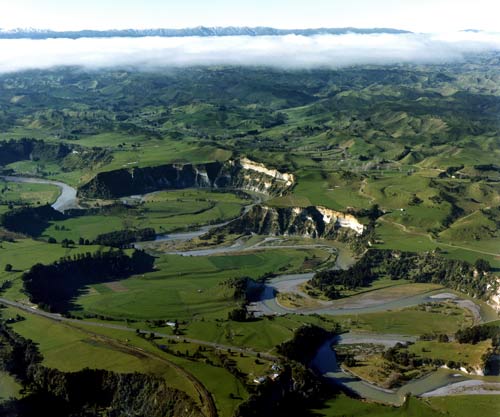
Almost every landscape in New Zealand has a complexity of soils. This is the result of prolonged depositing of airborne or alluvial soil, erosion by rivers and streams, and the subsequent re-sorting and depositing at new locations. This has left a topographic pattern ranging from steep slopes to flat terraces of various ages, with associated differences in soil qualities. This part of the Rangitīkei River has sedimentary-derived hills (background), high terraces with a deep loess cover, lower terraces (bottom left) with a thin loess cover, and Recent soils on the flood plain adjacent to the river.
Using this item
Reference: Les Molloy, Soils in the New Zealand landscape: the living mantle. Lincoln: New Zealand Society of Soil Science, 1988, plate 6.2
by Quentin Christie
This item has been provided for private study purposes (such as school projects, family and local history research) and any published reproduction (print or electronic) may infringe copyright law. It is the responsibility of the user of any material to obtain clearance from the copyright holder.