

Image
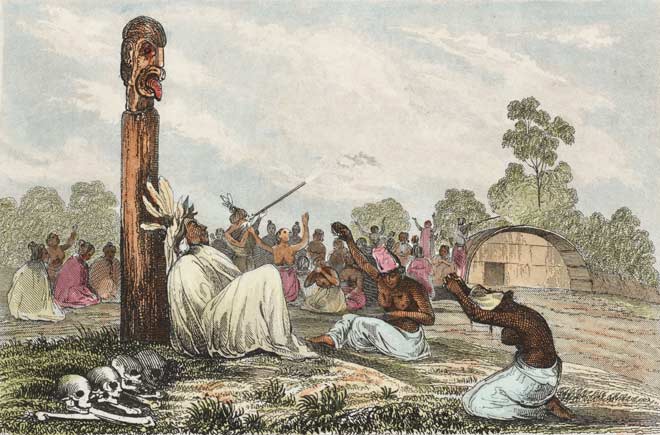
This engraving was made by Louis de Sainson, the artist with French explorer Dumont d'Urville's 1827 expedition around New Zealand. The body of a chief, with feathers in his hair, has been placed against the post and wrapped in a cloak. The two seated women are lacerating their upper bodies with sharpened shells, a traditional act of mourning known as haehae. Sometimes soot was placed in the cuts to preserve the scars, a forerunner of the practice of tattooing.
Using this item
Reference: A-327-004
by Louis Auguste de Sainson
Permission of the Alexander Turnbull Library, National Library of New Zealand, Te Puna Mātauranga o Aotearoa, must be obtained before any re-use of this image.