Story: Memorials and monuments

Memorial to John Grigg, Ashburton

Image
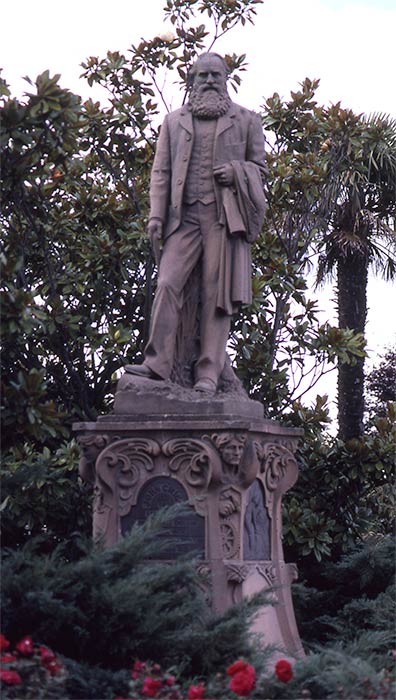
Memorial to John Grigg, Ashburton

This statue of pioneer settler John Grigg was unveiled in the centre of Ashburton on Canterbury anniversary day, 16 December 1905, four years after Grigg's death. The memorial was seen as a tribute to a pioneer who had transformed the swampy land around his property at Longbeach into a prosperous farm and had played a leading role in the export of frozen meat from Canterbury. Memorials to pioneers began to appear in small towns around New Zealand in the first decade of the 20th century. Grigg's statue was designed by the Christchurch architect S. Hurst Seager, and was executed by Christchurch sculptor Charles Kidson. At the corners of the base were four figures, symbolising justice, industry, patience and fortitude. Bas reliefs on three sides depicted agricultural activities – ploughing, stooking (bunching wheat sheaves in order to dry them) and shearing.

Using this item

Te Ara - The Encyclopedia of New Zealand

by Jock Phillips

This item has been provided for private study purposes (such as school projects, family and local history research) and any published reproduction (print or electronic) may infringe copyright law. It is the responsibility of the user of any material to obtain clearance from the copyright holder.

All images & media in this story

How to cite this page

Jock Phillips, Memorials and monuments – Civilian memorials, 1900–1945, Te Ara – the Encyclopedia of New Zealand, https://teara.govt.nz/en/photograph/32563/memorial-to-john-grigg-ashburton (accessed 4 June 2026).

Story by Jock Phillips, published 14 March 2012, updated 26 March 2015.

Comments

Ross Somerville (Te Ara)
30 August 2012
There's a biography of Charles Kidson in Te Ara's Biographies section. Follow this link.
Jock Phillips (Te Ara)
30 August 2012
Thank you very much for this information, which has allowed us to correct the name and origin of the sculptor on the site. The original claim that the sculptor was an Australian, Charles Kidston, came from The Star newspaper on 16 December 1905, page 5, which said that the sculptor was 'a Sydney artist, Charles Kidston'. However I note that The Press on 18 December 1905 correctly says he was Charles Kidson from Christchurch.
Quentin Wilson
29 August 2012
Note that the sculptor's name is NOT Kidston, but Kidson. Note also that he was NOT Australian. See below for the biographical details cited in the Christchurch Art Gallery's guide to artists and their works situated in Christchurch: The Kidson family immigrated from England to New Zealand. The Kidson family was joined by their son Charles after he had pursued art training in England. The idea behind Charles Kidson’s move to New Zealand from England was that the Nelson climate might improve his health. Kidson soon moved to Christchurch when he was appointed to the staff of the Canterbury College School of Art in 1892. However, in an effort to pursue his artistic interests and a higher wage, Kidson resigned in 1906 to pursue a full time career as sculptor and craftsman. Over the years Kidson carried out many important sculpture commissions. These include work on the Grigg Memorial in the Ashburton Domain, and the Kaiapoi Memorial Monument at Waikuku. Kidson did several busts of prominent citizens, these include Richard John Seddon, T.E Taylor, and Sir John Hall. Kidson created a portrait bust of Sir John Hall wearing mayoral regalia. The bust was commissioned in the honour of Sir John Hall who died on 25 June 1907 was the first chairman of the Christchurch Municipal Council 1862-3, and Mayor of Christchurch 1900. The bust was completed just before Kidson’s death of Bright’s disease on 2 October 1908.