Story: Shipwrecks

The wreck of HMS Orpheus

Image
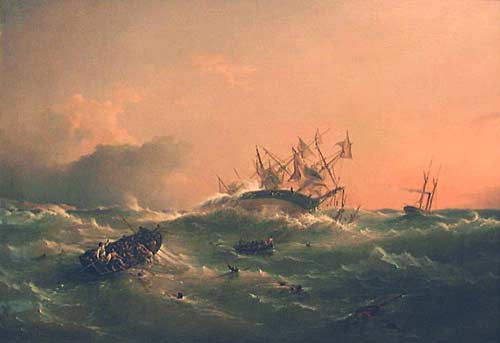
The wreck of HMS <em>Orpheus</em>

This painting by Richard Brydges Beechey depicting the wreck of HMS Orpheus on 7 February 1863 is dated September 1863. The steam corvette was carrying stores from Sydney for naval ships based in New Zealand during the New Zealand wars. It was wrecked crossing the bar of Manukau Harbour. Of the 259 officers and men on board, 189 died – the greatest ever loss of life from a shipwreck in New Zealand waters. Those who were saved had climbed into the rigging and then jumped into the water. They were picked up by boats towed out by the small steamer Wonga Wonga (right).

Using this item

New Zealand National Maritime Museum, P. A. Edmiston Trust Collection

by R. B. Beechey

This item has been provided for private study purposes (such as school projects, family and local history research) and any published reproduction (print or electronic) may infringe copyright law. It is the responsibility of the user of any material to obtain clearance from the copyright holder.

All images & media in this story

How to cite this page

Gerard Hutching, Shipwrecks – Māori shipwreck stories, Te Ara – the Encyclopedia of New Zealand, https://teara.govt.nz/en/artwork/7278/the-wreck-of-hms-orpheus (accessed 4 June 2026).

Story by Gerard Hutching, published 2 March 2009.

Comments

Steve Wood
29 January 2012
As children, in the nineteen fifties and sixties, my brothers and cousins and I spend much time walking the bush tracks and sandy beaches around Cornwallis and Kakamatua. We considered the place our 'playground' during the school holidays when we stayed at my uncles bach on Cornwallis Beach. Only the stone wall he built to ward off erosion by the tides, remains oday. It's almost the only structure remaining as evidence of what was once a beachside 'town' of some one hundered bachs situated in two rows, one literally on the beach and one above it on the rise of land bordering the pine forest.one hundred faamilies spent their every holiday there, picnicing, fishing from boats or the Wharf, netting from the beach and always coming homem with a bountiful catch. New Years Day was annual sports event day with children of all ages competing in running and other events. Somewhere near Kakamatua lost in the bush now, are graves of some of the souls lost in the Orpheus disaster. From memory, the graves were outlined by very old seashells and wooden crosses, and surrounded by a wooden fence structure. I visted the area recently with my 16 year old daughter and described to her the old 'Cornie' I knew. It seems like paradise lost to me now and I consider I was blessed with an enviable up bringing and family holdays that are unavailable to most today. Despite having an 'open to the wider public' status today, Corwallis has seemingly lost all of it's quanitness, it's seaside township charm and the beach seems a desolate and lonely place compared to it's 'heyday' in the earlier part of the last century when Cornwallis has a soul. All due to Sir Dove Myers' refusal to re-new the 99 year leases enjoyed by the 100 odd bach owners. Not his best decision in my opinion. Cornwallis died that day. Steve Wood