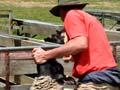
… The jobs of rural and urban veterinarians differ in many ways. Rural vets do … They deal with large, commercially valuable animals such as sheep, cows or horses, and may be called out at any hour of … work in 2008. Dairy cattle were 13% of their work, sheep and beef 12%, horses 9% and deer 3%. Pocket pets and …
Type: Story Page
… Joseph Ward was born and baptised on 21 August 1817 at Tixall, Staffordshire, … The group settled at Waimea West, where Ward engaged in farming and surveying, did some tutoring for the Redwoods, … Omaka area, eventually called Brookby, and stocked it with sheep, and his family moved there in 1854. In 1849–50 Ward …
Type: Biography
… The New Zealand Company The New Zealand Company was the first large … a few large companies involved in 19th-century New Zealand farming. A key company was the New Zealand and Australian … of these were Vestey, and Thomas Borthwick and Sons. Sheep farmers could sell their sheep to processors or they …
Type: Story Page
Part of story: Large companies … Grigg was baptised in the parish of Duloe, Cornwall, England, on 23 May 1828. He was the eldest of the three sons and … end of the year. He leased land at Otahuhu and began mixed farming. On 7 June 1855 he and Martha were married at … achievement in establishing a pure-bred flock of Leicester sheep is indicated by his success as a show-ring exhibitor …
Type: Biography
… Topography Much of Northland is undulating to moderately steep hill country that has … it can be used by the trees. Gley podzol soils are used for sheep and beef farming, and dairying, but need lots of initial … Northland …
Type: Story Page
… Before 1876 education was spasmodic and mainly private. It focused on the traditional subjects … declined in primary schools. To encourage an interest in farming among children, in 1921 boys’ and girls’ … had two farms: 16 hectares with dairy and pigs, and a sheep–beef–forestry farm of 82 hectares. Half of the pupils …
Type: Story Page
… William Henry Terry Tucker was born at Auckland, New Zealand, on 5 January 1843, the son of Elizabeth … of Victorian whiskers. After experience in Hawke's Bay with sheepfarming and military volunteers, Tucker moved to Poverty Bay …
Type: Biography
… High demand Superphosphate has been a reliable and cost-effective … fertiliser in New Zealand since 1882, especially on sheep and dairy farms. Once it was known that superphosphate … country. The result was a huge increase in hill country farming, both privately and through government schemes. …
Type: Story Page
Part of story: Superphosphate … Hopes and mixed success Roads were viewed as an economic and … provincial treasury. Yet in the road’s first year 40,000 sheep and 25,000 cattle were driven over it to feed the gold … the whole, roads were crucial to the development of towns, farming, and other industries. Many of the roads built by …
Type: Story Page
… outlook that shows the diversity of the Hawke’s Bay landscape. There are ranges, hills and plains, watched over … resources. In the early 2000s pastoral and horticultural farming and processing were still its most significant … 1840s. They were followed by the first pastoral runholders (sheep farmers) in 1849. Sheep, and later beef cattle, were …
Type: Story Page
… now sprawls across these plains, but the wider Canterbury landscape has changed little. Behind the curved coastline of … other New Zealand city, it has kept strong ties with its farming hinterland. Farming is now less important in the … farmland with long lines of shelter belts, and high-country sheep runs with lonely homesteads in magnificent mountain …
Type: Story Page
… Farm exports Farming was hampered by economic depression in the 1920s and 1930s, and labour shortages in the 1940s caused by the Second World War. Between 1930 and 1950, the growth in sheep numbers slowed, and wool production and prices swung …
Type: Story Page
… Mediterranean visions New Zealand’s future was not always envisaged as a grassland … products led to an increase in dairy farms. Low-yielding sheep pastures were converted into intensively stocked, … clover. As well as using the best strains, New Zealand farming benefited from technical improvements in grassland …
Type: Story Page
… Introduction The craze for goat farming in the mid-1980s was surpassed by the effort that … into the introduction of camelids – alpacas ( Lama pacos ) and llamas ( Lama glama ) from Chile. Investors put … in the tooth While alpacas are much easier to care for than sheep, they do need their toenails trimmed from time to …
Type: Story Page
… the rest of the farm buildings, but far enough from the sheep yards or cowshed to avoid the noise, dust and smell. On large properties the main house is known as … the farmhouse. At the back door there is usually a verandah or porch to hang wet-weather gear to dry, and a …
Type: Story Page
Part of story: Farm buildings … Stock and station agencies played a vital role in rural … agents Agents working out of rural towns service the local farming community. Some deal only with livestock, while … and plant in 1893. It took three days, and 109,000 sheep were sold, as well as cattle and horses. Sales Stock …
Type: Story Page
… Intensification in farming In the immediate post-war years, Britain wanted as much food as New Zealand could export, so the government focused on maximising … securing export markets. There was a stockpile of sheep meat. By the early 1980s, government support for …
Type: Story Page
… Auckland Islands The Auckland Islands, with a total land area of … station was based there. Human settlement and sheep severely damaged the flora, but the eradication of sheep, cats and rats has led to a revival. In the 2000s … Auckland and Campbell islands …
Type: Story Page
… flows into the Buller). The 863-m saddle was used by Māori, and crossed by Henry Lewis in the early 1860s. It was not an … is a popular five-day, 66-km walk through forested and farming mountain country east of the Lewis Pass Road. It was … crossed in 1852 by Edward Lee and Edward Jollie with 1,800 sheep, opening the inland route for Canterbury runs to be …
Type: Story Page
… Before powered machinery, farming was heavy, time-consuming manual labour. Fields were … using horse or bullock-drawn ploughs. Cows were milked, sheep shorn, and crops planted and harvested using human or animal power. …
Type: Story Page
Part of story: Rural services