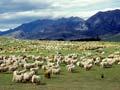
… A country town is a place in which the economic and social life of the community depends largely on the … small New Zealand towns which have had no relationship to farming. Some were port towns, like Lyttelton, which owed … east coast of the South Island, farm workers lived on the sheep runs in men’s quarters or around the homestead. Only …
Type: Story Page
Part of story: Country towns … In New Zealand the National Institute of Water and Atmospheric Research makes high-precision measurements … electricity. All ruminant livestock (such as cows, sheep, deer and goats) produce methane by belching as a … Greenhouse gas measurements in New Zealand …
Type: Story Page
Part of story: Atmosphere … North Island The traditional North Island fence was more heavily built and more expensive than … proportion of cattle, which are much harder on fences than sheep. Fences consisted of five plain wires and two runs of …
Type: Story Page
Part of story: Farm fencing … widely accepted that humans have the right to own, use and, in some circumstances, kill animals. However, most … include various kinds of neglect. It also restricted some farming practices, and increased penalties. Farming … docking tails of dairy cows, caging hens and exporting live sheep. Animal rights activists, angry about inconsistent …
Type: Story Page
… Prebble was born on 9 May 1833 in Mersham, Kent, England, the youngest of six children of James Prebble, a … skills in butter and cheese making, and also began farming in her own right. With John Gebbie's encouragement … Prebbleton. They built up a large dairy herd, and also ran sheep and a Clydesdale stud. In addition Mary earned large …
Type: Biography
… Settlement of the Southland plains began in the mid-1850s. The shore whaling … the port, and Invercargill the service town for the new farming districts, in due course displacing Riverton as … capacity of one Southland farm fell from 50,000 to 20,000 sheep. The plague eased in the 1890s, but recurred in the …
Type: Story Page
… Arapawa Island 75-sq-km island flanked by Queen Charlotte Sound, Tory … Cooks Lookout was erected in 1970. Herds of feral goats, sheep and pigs, all with distinctive genetic histories, … 2010s the main economic activities were forestry, mussel farming and summer tourism. The pylons for the lines that …
Type: Story Page
… Thomas Mason was born in York, Yorkshire, England, on 28 July 1818, the first of three children of John … School from 1829 to 1832 and then worked in business and farming. On 16 November 1840 at Bishophill, York, he married … He had land at Mataikona in Wairarapa where he ran sheep and surplus cattle. By mid 1855 he had also secured …
Type: Biography
… From colonial times until the 1960s, local dances in town and country areas were opportunities for women to signal … Canterbury woman Elsie Clogstoun, who came from a wealthy sheep-farming family, recorded in her diary in the early 1880s: …
Type: Story Page
Part of story: Rural clothing … also reproduced on a daily basis through national symbols and everyday items. These range from official symbols such … as pioneering farmers was expressed in the use of sheep as a symbol of New Zealand. Sheep also appeared in … bush shirt have been kiwiana cultural icons originating in farming. Native flora and fauna Indigenous plants and …
Type: Story Page
… Collectively, Brown, Pallic, Podzol and Semi-arid soils cover more than 69% of New Zealand. They … such as those on the Southland plains, make good land for sheep, beef and dairy farming. The wrong soil When early European explorers saw …
Type: Story Page
… Transforming the landscape Horses played a vital part in transforming New Zealand’s landscape in the 19th century. Millions of acres of … horses, as well as some released or escaped from local sheep stations. In 1979 there were 174 horses recorded in … Horses and the environment …
Type: Story Page
… they had brought from Polynesia. However, due to New Zealand’s cooler climate, and different vegetation and soils, … and butter to London in 1882 made dairying and fat-lamb farming viable, adding economic incentives to clear land and … 1949. Fencing To stop the spread of stock diseases, such as sheep scab (a small mite which ruined the fleece) and …
Type: Story Page
… was born probably in 1835 or 1836, in County Wicklow, Ireland, third daughter of Thomas Revell, farmer, and his wife, … Kaiapoi on 16 June 1857. Afterwards they lived at Fernside sheep run, near Rangiora, where Henry had been farming with his brother Charles Torlesse. On 29 September …
Type: Biography
… with a tilting engine to allow for vertical take-off and landing, and was granted New Zealand patent number 87637. His … Hamilton’s jet boat Irishman Creek station, a high-country sheep farm near Lake Tekapo, is threaded with mountain …
Type: Story Page
… Early vegetation Before humans settled in New Zealand around 1250–1300 CE, the Whanganui region was covered by … felling hill-country forest to turn it into grassland for farming. Between 1880 and 1910, dense clouds of smoke were … 1885 and 1905. In the 2010s, the land was mostly used for sheep and cattle farming, and some dairying, with extensive …
Type: Story Page
… Division was set up within the Department of Scientific and Industrial Research (DSIR), led by Les Grange. After a … was growing concern about soil erosion on land cleared for farming. The government ordered a commission of enquiry and … extent and significance of erosion. A royal commission on sheep farming denounced the DSIR report on the high country …
Type: Story Page
… born in the parish of Barony, Glasgow, Lanarkshire, Scotland, on 15 May 1820. He was the fifth child and third son of Barbara Stirling Rennie and her husband, … built a zoo. In 1857 he established a pedigree cattle and sheep farm on Motutapu, which he farmed until 1869. His …
Type: Biography
… came late in the story of Pākehā settlement, had equal standing with regions such as Taranaki, Hawke’s Bay, Whanganui … distinctive about Manawatū’s time in the sun? Its rich farming economy rested on the three pillars of dairying, … comparison, Taranaki relied on dairying, and Hawke’s Bay on sheep. Manawatū lay at the heart of the booming lower North …
Type: Story Page
… (known as Eileen) Neilson was born in Lyttelton, New Zealand, on 31 December 1883 to Sarah Alma Brown and her … When her brother Charlie returned in 1919 the two continued farming together. He died in 1929 and she carried on with … in my day', neighbours recall that she crutched and dagged sheep, helped with the fencing and stock work, and often …
Type: Biography